

Financial statements can be generated in seconds using Tally, Zoho, and AI-powered tools. But will those statements always be accurate? Not necessarily. While the software keeps track of all the information that goes in, it does not determine whether a transaction is a part of this month or next, the value of an old asset, or a pending dispute a liability.
This requires human judgment. Even if the decision made at the beginning is wrong, the report generated will look polished and professional. But it will not represent the true financial position of the business.
This is the reason why accounting principles continue to be important nowadays. They lay down rules for decision-making behind every accounting entry and help accountants recognize mistakes before they escalate to bigger problems. When people wonder why they learn accounting principles in the era of AI, this proves that some skills cannot be replaced by any software.
We will illustrate the whole guide with a single example, that of Vantage Electronics, a mid-sized electronics retailer with both a physical store and e-business.
What Are Accounting Principles?
Accounting principles can be defined as a group of standard guidelines that facilitate the recording of business transactions as well as the preparation of accurate and reliable financial statements.
In the absence of such principles, it is very hard for banks, investors, accountants, as well as the businessman himself, to compare the financial statements of two different firms. These principles give directions about how to record transactions like purchase, sales, expenditures, and payments. If you are interested in the field of finance, you must know what accounting principles are. Knowing accounting policies and principles enables you to detect mistakes that cannot be identified by softwares sometimes.
Significance of accounting principles is as follows:
Helps in maintaining consistency in financial data.
Systematic recording of transactions.
Makes the financial statements more understandable.
Help management in making better decisions.
Assists in analyzing financial performance by investors and lenders.
Help the investors, lenders and other stakeholders to interpret financial data.
These basic accounting principles form the framework upon which businesses from various backgrounds maintain their accounting information.
GAAP vs IFRS vs Ind AS: Understanding the Frameworks
Accounting principles are applied through formal accounting frameworks and standards.
Indian GAAP (Generally Accepted Accounting Principles) refers to the set of accounting principles and standards that are practiced in India. Accounting principles consist of accounting standards and regulations that have been developed along with the activities carried out by the ICAI (Institute of Chartered Accountants of India) and MCA (Ministry of Corporate Affairs) and these are of great significance.
IFRS (International Financial Reporting Standards) refers to the accounting standards developed by the IASB (International Accounting Standards Board). These accounting standards are adhered to or adapted by more than 140 nations and help in making the financial statements of organizations comparable internationally.
Ind AS (Indian Accounting Standards) are the accounting standards that are practiced in India and are consistent with IFRS but are not identical with IFRS. It is the Ind AS that Indian organizations are supposed to follow now if they are above a certain size.
Why is this significant? As companies in India look to attract foreign investment, go public and be a part of global organizations or GCCs (Global Capability Centers), knowledge of such frameworks become highly useful for finance professionals. Understanding GAAP principles in practical terms can enable them to deal with international financial reporting, ESG (environmental, social and governance) disclosure and preparation of financial reports from various locations.
Core Accounting Principles
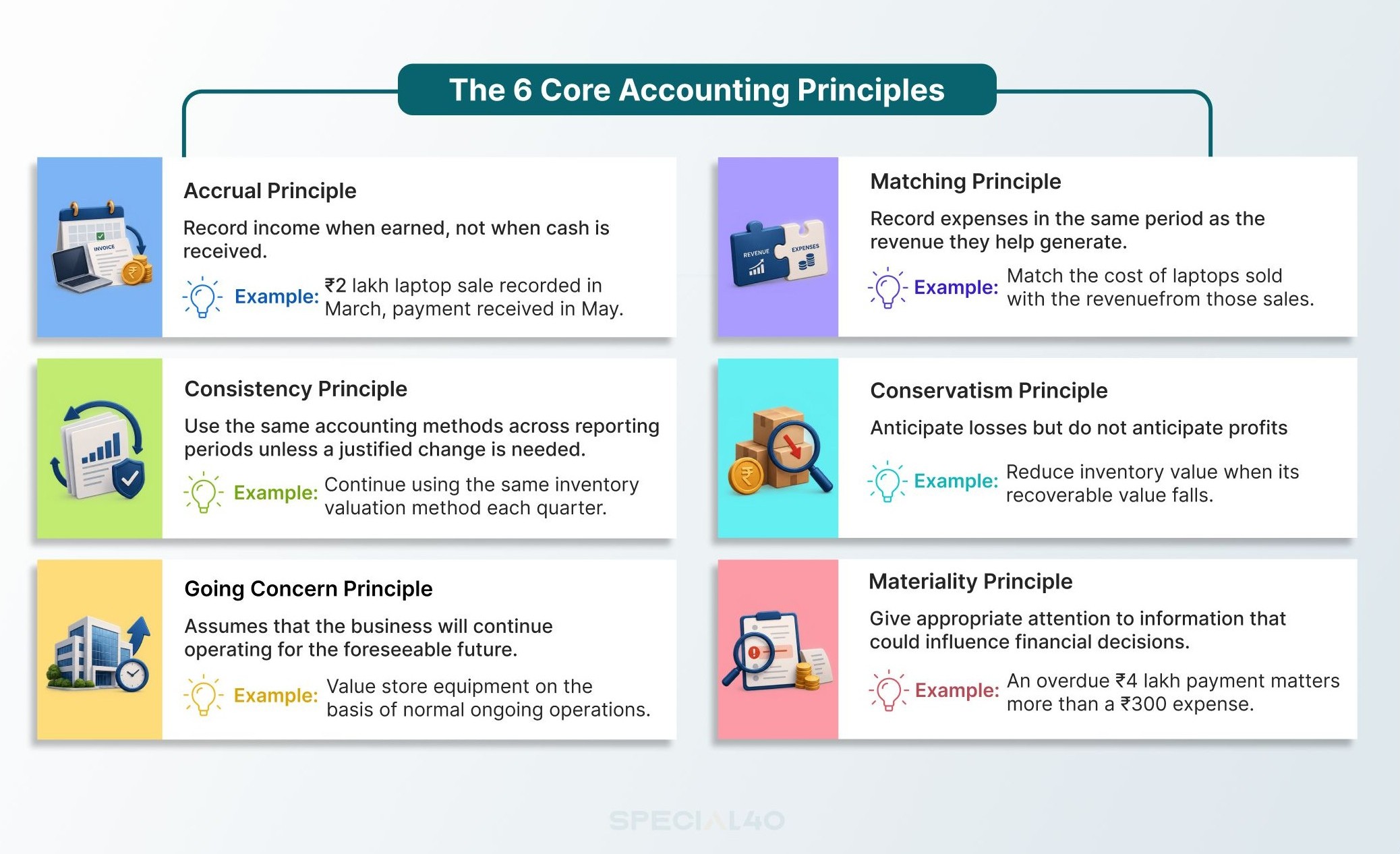
1. Accrual Principle
Under the Accrual principle, a firm should record its income and expenses at the time of their occurrence and not at the time cash is received or paid.
Vantage, the firm, sells laptops worth ₹2 lakhs to a buyer in March on 60-day credit terms. This transaction is recorded during March although the cash is received in May. The most important point here is the timing of the transaction itself whether it took place at the time of order, invoice or delivery. Software simply records the date the accountant enters, so choosing the right date is the accountant’s responsibility.
2. Consistency Principle
The consistency principle refers to the application of the same accounting methods through different accounting periods unless there is a good cause for changing them.
Vantage applies the weighted average method to inventory valuation and follows it through each quarter. Businesses are advised against altering accounting methods as a means of making a bad period look good as this does not reflect the true financial state of the organization.
The software can calculate the value of the inventory using various methodologies, but the accountant should make sure that the selected method is appropriate and consistently applied.
3. Going Concern Principle
Under the going concern principle, it is assumed that the company will operate in the future and pay its debts unless evidence suggests otherwise.
Vantage values its store fixtures and its delivery vehicles based on their usual accounting value and not the forced sale value since it is presumed that the company will continue its operations.
If Vantage is in a serious financial crisis, then the accountant should rethink the going concern principle. If the business may not continue, asset values and financial reporting may need to change significantly.
4. Matching Principle
The matching principle requires expenses to be recorded in the same period as the revenue they helped generate.
Vantage sells laptops for ₹2 lakh in March. The laptops cost Vantage money when it bought them, maybe in January or February, and it may pay the supplier later. Vantage records that cost in March, when the sale is recorded, not when it bought the laptops or paid for them.
If the cost were recorded earlier or later, March would show a wrong profit. The sale would appear with no cost, which makes profit look too high. It is important for the accountant to know what inventory cost goes with a particular sale, especially if there have been various costs of purchasing the stock within several months. The software uses the chosen method of costing, but the information should be correct.
5. Conservatism (Prudence) Principle
The conservatism principle, also called prudence, states that firms must provide for anticipated losses but not for anticipated gains in their accounts because gains have not yet been realized.
For example, Vantage possesses smartphones worth ₹50,000 which can be sold for ₹35,000. It should write the stock down and record the ₹15,000 loss now, before any sale. However, if a product's resale value increases unexpectedly, the gain is recorded only when they are actually sold. The accountant must estimate the loss using evidence such as market prices, because the estimate affects the profit and Balance Sheet.
6. Materiality Principle
The materiality principle is concerned with information that is significant enough to impact a financial decision.
A ₹300 stationery expense may not require separate disclosure in financial statements. However, a ₹4 lakh unpaid debt from Vantage's corporate customer could significantly affect the business and deserves attention.
The concept of materiality principle does not have anything to do with small or big amounts of money. It is all about whether the given information might affect the decision-making process of any person who looks at the accounting statements. So the accountant must decide what requires a separate presentation and what can be grouped with other items.
Common Accounting Principles Mistakes Beginners Make
Understanding accounting principles mistakes helps students avoid mistakes which could make the financial statements misleading.
Accrual mistake: Entries recorded based on receipt or payment of cash rather than the actual occurrence of the transaction. Example: Vantage Electronics has sold laptops worth ₹2 lakh in March on credit, but they have received payments in May. If sales are recorded in May only, then the income will appear in the incorrect accounting period.
Consistency mistake: Switching accounting or valuation methods without a legitimate reason, which makes comparison of financial outcomes difficult. Example: Vantage Electronics applies the weighted average method to determine the cost of inventory but changes from this method to another one in the next quarter for inflating its profits.
Going concern mistake: Assuming a company will operate forever despite its problems needing reconsideration. Example: Vantage Electronics is experiencing severe financial troubles and might be unable to meet its financial obligations; however, the accountant prepares its financial reports assuming that everything is normal in the firm’s operations without analyzing the situation.
Matching mistake: Entering an expense in the wrong period as it does not match the related income. Example: Vantage Electronics sells laptops worth ₹2 lakh in March but records their purchase cost in April. This makes March's profit appear higher than it actually is.
Conservatism mistake: Recognizing losses as well as gains which were not made yet. Example: The smartphones of Vantage Electronics have a value of ₹50,000 but their value is reduced to ₹35,000. Overlooking the loss of ₹15,000 can lead to overstated value of inventory. In the same way, recognizing any expected profit before making the sales is premature.
Materiality mistake: Ignoring important information due to its unimportant appearance or overvaluing unimportant items while important ones are neglected. Example: Vantage Electronics ignores the overdue customer payment of ₹4 lakhs since it is sure that he will pay, but spends time on reporting an unnecessary expenditure of ₹300 on stationery separately. The unpaid debt could have a much greater impact on financial decisions.
Other common accounting errors include learning definitions by heart but not knowing how to apply them in real life, believing that there is one right solution for each accounting decision, mixing up estimates with proven facts, memorizing entries without knowing the underlying transactions, and more.
These accounting judgment mistakes happen due to the fact that sometimes a person fails to understand the transaction or makes an unsupported assumption.
Conclusion
Accounting Principles form the fundamentals of practical accounting.
Software may be used to record an entry within seconds; however, it cannot verify the correctness of the initial decision made. Principles like accrual principle, consistency, going concern, matching, conservatism and materiality are all based on human judgment and only then comes the processing of the data in Tally, Zoho or any other system of accounting.
The distinction of using accounting software and being a reliable finance professional nowadays will be based on the ability of the person to make use of the logic behind every single accounting transaction. The study of accounting principles for B.Com students and commerce students must therefore not be limited to bookish definitions alone.
If you know the principles but haven't used them in filing GST returns, Tally/Zoho entries, and preparing financial statements, then the placement oriented program at Special40 in Kochi will surely fill that gap.
FAQ
What are the accounting principles?
Accounting principles can be defined as a group of standard guidelines that facilitate the recording of business transactions as well as the preparation of accurate and reliable financial statements. The accounting principles include accrual, consistency, going concern, matching, prudence and materiality.
What is the difference between accounting principles and accounting standards?
Accounting principles are the basic ideas that guide how financial information is recorded and reported whereas Accounting standards provide specific rules and guidelines for applying these principles in practice.
Why is the accrual accounting principle important?
Under the accrual principle, the incomes and expenditures are recorded at the time they actually happen and not at the time when cash transactions take place.
Do accounting principles apply to small businesses too?
Yes, accounting principles apply to small businesses too, but they can be followed in a simpler way than the formal rules used by large companies.
Are accounting principles the same as GAAP?
They are not entirely identical. GAAP (Generally Accepted Accounting Principles) refers to a broader framework of accounting rules and standards. Accounting principles are the underlying concepts that help guide financial reporting within that framework.