

The Reserve Bank of India (RBI) is the regulatory authority that deals with matters relating to controlling inflation, interest rates and the overall financial stability of the country. One of the key rates that RBI maintains and regularly reviews is the repo rate. Repo rate is the rate at which the RBI lends funds to other banks.
When the RBI changes this rate, it affects us through home loans, personal loans, fixed deposits, and other financial products.
The Reserve Bank of India (RBI) has recently announced a key decision: a 25 basis-point (0.25%) increase in the repo rate, moving it from 5.25% to 5.50%.
This is the first hike in the repo rate since February 2023, but what exactly is a repo rate?
Why has the RBI hiked the repo rate suddenly? What impact will the repo rate hike have on your monthly EMI and savings? In this guide, we will explain it all in simple words.
What Is Repo Rate?
The repo rate refers to the interest rate at which the RBI lends short-term money to commercial banks against government securities or eligible collateral. The commercial banks have to repay the principal and pay an interest rate decided by the RBI.
To understand the concept of a repo rate, think of the RBI as the 'banker to the banks.' Like how you would take a loan from a nearby SBI or HDFC or ICICI branch in case of need of money, commercial banks take a short-term loan from the RBI for their daily working capital needs.
When the repo rate goes up, borrowing becomes costlier for commercial banks. To maintain their margins, banks pass on these increased funding costs to retail consumers by raising their benchmark lending rates. This cools down money supply and demand in the economy.
Why Did the RBI Hike the Repo Rate?
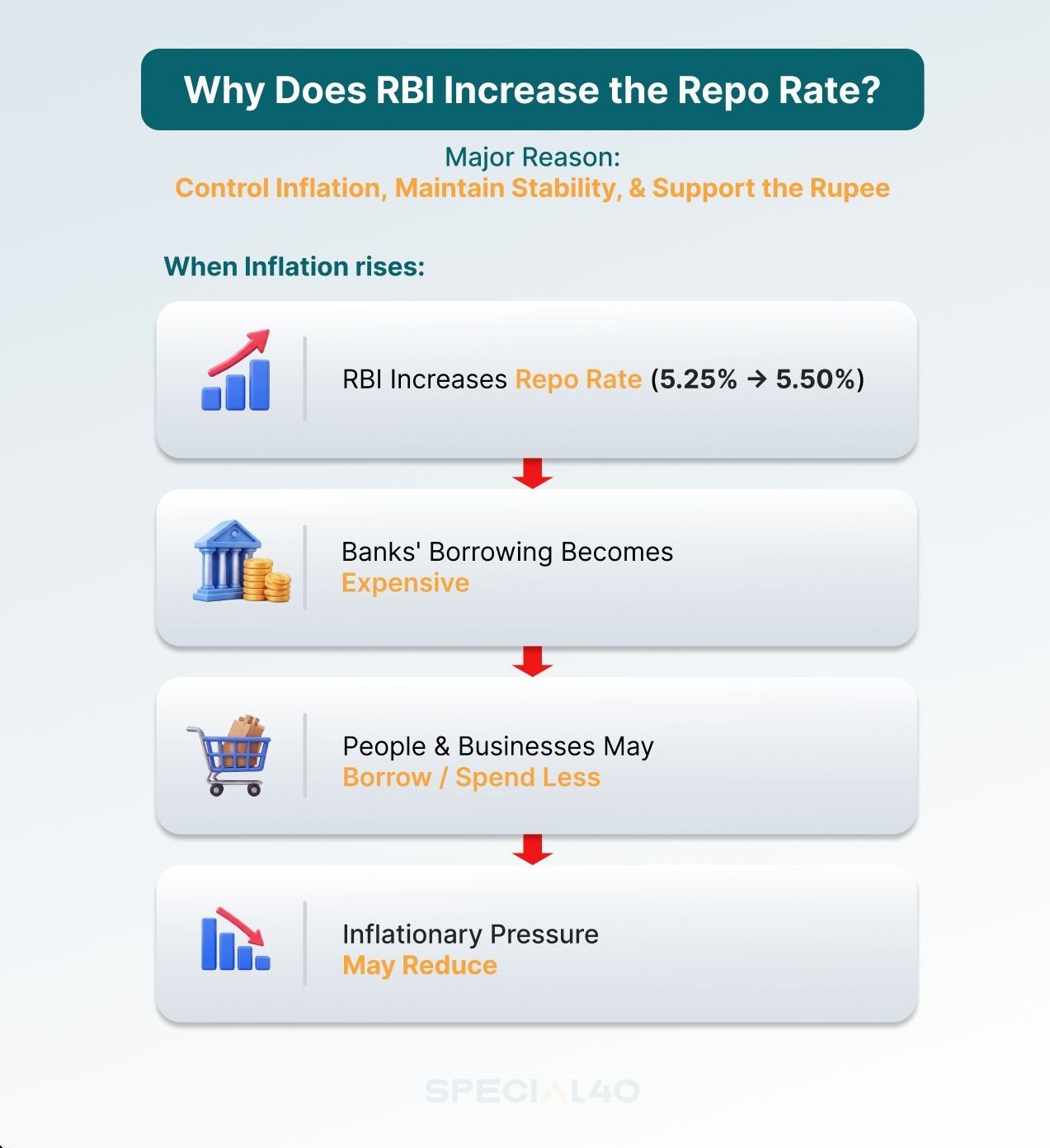
When the prices of goods and services in an economy start rising too fast, the RBI steps in to prevent the economy from overheating. By adjusting the interest rates primarily to maintain economic balance and keep inflation in check.
By increasing the repo rate, borrowing money by businesses and individuals becomes costlier and demand for loans reduces leading to lower spending by enterprises and individual investors. This has the effect of decreasing market prices and consequently lowering inflation. By adjusting the repo rate, the RBI attempts to balance economic activity with price stability.
A repo rate hike does not guarantee that inflation will immediately decline. Its effects depend on several factors, including how banks respond and how the economy develops.
How Does the RBI Repo Rate Hike Affect Your Loans and EMIs?
When the Reserve Bank of India (RBI) increases the repo rate, the cost of borrowing from banks can increase. Banks usually lend funds at a rate of interest that is in line with their funding costs and the rates at which they lend money. As a result, borrowers who have eligible floating rate loans can be impacted in terms of change in rate of interest, change in EMI or change in tenure of the loan.
Why Loan Interest Rates Go Up
Many floating-rate loans—especially home loans—are directly linked to an external benchmark, such as the RBI Repo Rate (External Benchmark Linked Rate / EBLR). When the repo rate increases, your loan interest rate also increases which may lead to higher EMI or longer tenure.
The precise outcome depends on your lender's repayment policy, outstanding principal, remaining tenure, and loan agreement.
Not all loans are directly affected by the repo rate. Some of them use a different base rate, and therefore, it is important to check your loan contract.
Will Your EMI Increase Immediately?
No. A repo rate hike does not automatically mean your EMI will change the next day.
Reset Dates: Your loan’s interest rate and EMI change only when your lender reaches your scheduled loan rate reset date (which could be monthly, quarterly, or semi-annually depending on your agreement).
Fixed-Rate Loan Exemption: If you have a purely fixed-rate loan, this hike will not change your interest rate or monthly payment.
EMI Calculation: What Happens When the Interest Rate Rises?
To see how a 25 bps hike plays out in real life, consider a ₹1 Crore home loan over a 20-year tenure:
Metric | Before Rate Hike | After 25 bps Rate Hike | Difference / Impact |
Interest Rate | 8.50% | 8.75% | +0.25% |
Monthly EMI | ₹86,800 | ₹88,400 | +₹1,600 / month |
That's about ₹1600 extra every month. If that higher rate stayed unchanged for the entire 20 years, you would pay ₹3.8 lakh more interest.
This calculation is indicative, and it does not represent the rate of any particular bank. A customer's EMI would depend on his/her outstanding principal, remaining tenure, rate of interest, reset schedule, and other terms and conditions. The impact will not be immediate, as several banks are likely to extend loan tenures instead of raising monthly EMIs.
What Does a Repo Rate Hike Mean for Your Fixed Deposits?
A repo rate hike isn't bad news for everyone—it can actually benefit savers and risk-averse investors!
Good News for Savers: When interest rates rise, banks eventually offer higher interest rates on new FDs and renewals.
What About Existing FDs? If you are already locked in a Fixed Deposit at 7.00%, a repo rate hike does not automatically raise it to 7.25%. Your existing FD continues at the rate locked in at the time of opening.
How to Benefit: The higher interest rates will apply when you open a brand-new FD or renew an existing one after banks adjust their deposit slates.
Understand Financial Changes and Build Practical Finance Skills
The 25 bps repo rate hike from 5.25% to 5.50% is a strategic step by the RBI to keep inflation in check. While it means borrowers with floating-rate home loans will likely face higher EMIs or longer tenures, it also brings fresh earning opportunities for fixed-deposit investors. The changes in the repo rate will give you an idea about how monetary policy will affect individuals, business organizations and the economy at large.
For commerce graduates and aspiring finance professionals, learning concepts like interest rates, inflation, banking, and financial analysis is an essential part of preparing for a career in finance.
Want to build practical finance and accounting skills? Check out Special40, a CA-led, job-oriented finance and commerce career development program that combines practical accounting and taxation training with hands-on learning and industry exposure.
FAQ
Why did RBI increase the repo rate from 5.25% to 5.50%?
The RBI hikes repo rate to cool down the current surge in inflation by making borrowing expensive, thus lowering overall consumer spending and demand.
Does a repo rate hike affect existing fixed-rate home loans?
No. Purely fixed-rate loans remain unaffected by repo rate changes, as your interest rate is locked in for the agreed fixed period.
Should I increase my EMI or extend my loan tenure?
If your cash flow allows, it is better to pay higher EMI. Increasing the tenure will keep the monthly payment the same but increases the overall interest paid over the life of the loan.
What happens when the RBI hikes the repo rate?
When the RBI hikes the repo rate, borrowing money can become more expensive for banks and customers, while banks may eventually offer higher interest rates on new fixed deposits.
Will every home loan EMI increase after a repo rate hike?
No. The impact will depend on whether the loan is indexed to the affected benchmark and any relevant date of reset specified under the loan documents and the specific terms of the lender. Fixed-rate loans generally do not react in the same manner as benchmark-linked floating rate loans.
What does a 25-basis-point increase mean?
One basis point is equal to 0.01 percentage points, so that a 25-basis-point increase is an increase of 0.25 percentage points (e.g., a rise from 5.25% to 5.50%).