

You pay taxes each and every day. Whether you are buying a new shirt, earning your monthly salary, or drinking coffee, some of your hard-earned money will definitely end up in the hands of the government.
But have you ever asked yourself where the tax money goes after it leaves your hands? Who collects it, how does it move around, and What is the difference between the tax charged on your shopping bill and the tax charged on your payslip?
Here's the question most people never ask: when you pay GST for that shirt, do you give it to the government directly? Actually, no — the shopkeeper receives it initially. But then how does it actually get to the government?
To truly understand how tax works, it's not enough to simply analyze tax rates. We need to follow the money. In this guide we will help to understand the real difference between GST and income tax.
Two Routes Tax Can Take: Direct vs. Indirect
Before looking at a specific example, we need to understand that tax can reach the government in two different ways.
The Direct Tax: The taxpayer pays the government directly. This is how Income Tax works — there's no middleman between your earnings and the treasury.
The Indirect Tax: Tax is collected by a business or seller, who accounts for it and then pays it to the government. This is how GST works — the shopkeeper sits between you and the government.
Want to effortlessly understand almost any tax concept? Focus on this one distinction. The moment you figure out if a tax is "direct" or "indirect," its entire behavior suddenly makes perfect sense.
What is GST?
Goods and Services Tax (GST) is a value-added tax imposed on goods and services at each point of sale.
This new tax system was introduced to substitute the web of old indirect taxes such as Excise Duty, Service Tax, VAT, and Luxury Tax.
Because India uses a dual-GST model, the tax is split depending on where the transaction happens:
CGST (Central GST): Collected by the Central Government on intra-state sales.
SGST (State GST): Collected by the State Government on intra-state sales.
IGST (Integrated GST): Levied on inter-state trade and imports, collected by the Centre and shared with the destination state.
What is Income Tax?
Income tax is a direct tax that governments levy on the financial income generated by individuals and businesses. This money is used to fund public services, infrastructure, and government operations.
So, the simplest way to understand these tax payment routes explained is:
GST follows the transaction. Income Tax follows the income.
This also explains the deeper difference between GST and Income Tax:
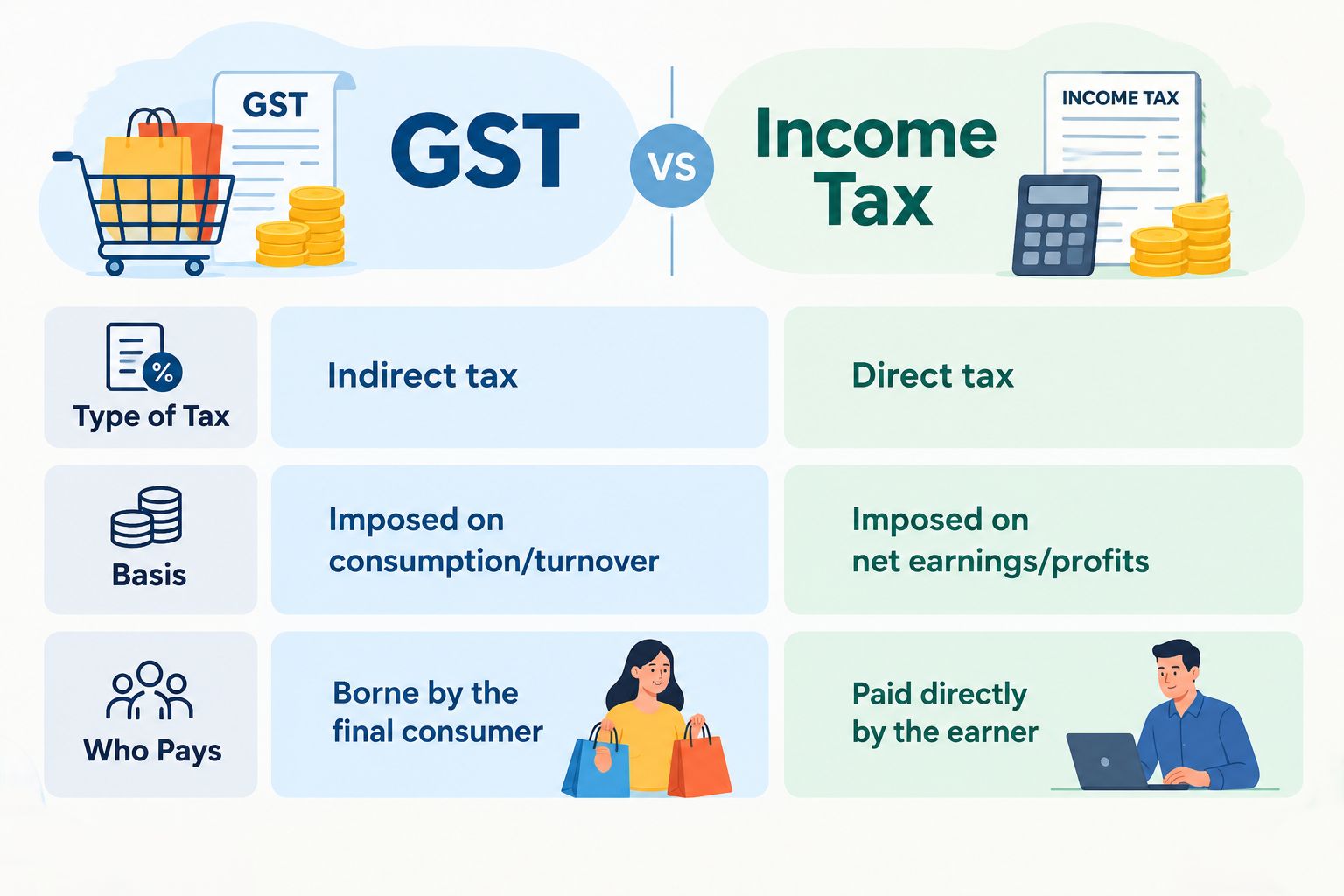
The GST Journey and the Input Tax Credit
To understand GST, consider the following example of retail purchase. Suppose that you have bought a shirt worth ₹2,000 with a GST of 5%. The calculations would be as follows:
Shirt price: ₹2,000
GST at 5%: ₹100
Total you pay the shopkeeper: ₹2,100
Rewinding the supply chain
Before the shirt got to your hands, the shopkeeper had purchased it from a wholesaler for ₹1,500.The wholesaler had to charge GST too:
Wholesale price: ₹1,500
GST (5% of ₹1,500): ₹75
Total the shopkeeper paid: ₹1,575
Understanding Input Tax Credit (ITC)
Here comes the tricky part for the shopkeeper. The shopkeeper has already paid ₹75 in tax to purchase the shirt, and now he/she is collecting another ₹100 in tax from you. This would mean that the same shirt will end up being taxed twice.
To prevent exactly this, the tax system uses a mechanism called Input Tax Credit, or ITC. It allows businesses to deduct the tax they've already paid on their purchases from the tax they collect on their sales.
GST collected from you: ₹100
Minus GST already paid (ITC): −₹75
Net GST paid to the government: ₹25
The value-added reality
Look closely at what actually happened in the shopkeeper's business. The shopkeeper bought the shirt for ₹1,500 and sold it to you for ₹2,000, adding ₹500 worth of value to it. And 5% of the ₹500 value added is actually ₹25. With Input Tax Credit, tax is collected by the government in an incremental manner at every stage of the journey, which ensures that the business is only taxed based on the value added.
But there’s one important detail that’s easy to miss. At each stage of the supply chain, starting from the manufacturer, supplier, wholesaler, up to the retailer, the business pays GST only on the value it adds. However, the final cost of the tax is ultimately borne by the consumer who buys the product.
Think about it this way. The manufacturer pays GST on their value addition and passes the cost forward. The supplier does the same. The wholesaler does the same. The retailer does the same. At every stage, GST gets collected and is largely offset through ITC — nobody in that chain actually absorbs the tax as a real cost.
The only person who cannot claim ITC is you, the end consumer. You pay the final GST amount in full, with no credit to set it against. So even though the tax was collected in small pieces at every stage along the way, all those pieces add up to exactly what you paid at checkout — the full ₹100 in our example.
This is precisely why GST is called a destination-based consumption tax: no matter how many hands the shirt passes through before it reaches you, the entire tax burden flows downstream and lands on the final consumer, while every business in between simply acts as a collection point for their own share.
So the simplified journey looks like this: Wholesaler → Shopkeeper → Customer, with ITC connecting every stage — and you, the customer, ultimately bearing the full, final tax.
Watch our step-by-step video below to see exactly how this ₹100 moves through the entire GST and Income Tax journey.
The Personal Journey of Income Tax
While GST is tied to what you spend, Income Tax is tied directly to what you earn. It cuts out the middleman entirely, creating a personal financial pipeline between you and the government.
The journey of Income Tax really boils down to answering three fundamental questions:
What is your gross income?
What is your taxable income?
What is your tax liability?
Here's how that plays out. You earn an income. That income gets adjusted for applicable deductions and exemptions, which brings you to your taxable income. From there, your tax liability is calculated based on that taxable income. And finally, that liability has to be paid to the government.
The key distinction worth holding onto is this: GST follows the transaction. Income Tax follows the income. One starts with something you buy. The other starts with something you earn.
GST vs Income Tax: Side-by-Side Comparison
Feature | GST | Income Tax |
Connected to | Transaction/supply | Income earned |
Who collects first | Seller/business | N/A — paid by taxpayer directly |
Journey | Customer → Business → Government | Individual → Taxable Income → Tax Liability → Government |
Core mechanism | Input Tax Credit | Deductions/exemptions |
The real takeaway here isn't to memorize two separate chapters of tax law. It's to ask one simple question whenever you're trying to understand a tax: is this money connected to a transaction, or to income earned? That one question will tell you almost everything else you need to know about how it moves.
Final Thoughts: Shift Your Perspective
The next time you look over a store receipt or check your pay stub, don't just glance at the percentages or the deductions. Look at the movement of the money.
By understanding whether your cash is moving directly from your account to the treasury, or filtering incrementally through a chain of suppliers, you gain a far clearer view of how modern economies actually function behind the scenes.
Understanding the concept is the first step — actually applying it to real GST returns, ITC claims, and tax filings is where the job-ready skill comes from. Special40's placement-focused programme in Kochi is built to bridge exactly that gap, turning this kind of conceptual clarity into practical, workplace-ready tax and accounting skills.
FAQ
Do I pay GST directly to the government?
No. You pay GST to the seller or shopkeeper, who then accounts for it and pays the applicable net amount to the government.
What is Input Tax Credit (ITC) in simple terms?
ITC allows a business to deduct the GST it already paid on its purchases from the GST it collects on its sales, so tax isn't paid twice on the same value.
What's the main difference between GST and Income Tax?
GST is an indirect tax connected to a transaction or purchase, while Income Tax is a direct tax connected to the income you earn.
How is taxable income different from total income?
Total income is everything you earn. Taxable income is what remains after applying eligible deductions and exemptions — and tax liability is calculated on that taxable income, not your total income.
Is GST charged at every stage of a supply chain?
Yes — GST is charged at every stage, but thanks to Input Tax Credit, each business only ends up bearing tax on the value it actually adds, with the full tax burden ultimately falling on the final consumer.