

Once CA exams are completed, what is the next step for a CA graduate?
A career in finance is one of the most competitive paths, and becoming a CA opens doors to several roles in the finance industry.
From accounting, consulting, and auditing to entrepreneurship and leadership, CAs can choose from a wide range of finance career roles and build careers in audit, taxation, finance, consulting, banking, investment, risk management, corporate strategy, and entrepreneurship.
As technology is evolving rapidly, the finance landscape is gradually adapting to the changing environment. So are the finance job roles.
In the next five years, finance roles are expected to become increasingly integrated with automation and digital tools, streamlining routine processes and improving efficiency.
In this blog, we will explore career opportunities after CA. This will help you choose the right CA career path that aligns with your interests, skills, salary, and long-term goals.
Keep reading to find out job roles, salary ranges, and industries hiring for CAs, along with how to choose the right career after CA.
Why CAs Have an Edge in a Career in Finance?
CA course equips graduates with a multidisciplinary skill set in taxation, accounting, compliance, and analytics. It offers great value for job roles in India, as its curriculum is closely aligned with Indian tax and business laws.
Graduating as a CA opens doors to several finance career roles. Employers value CAs for their strong understanding of accounting, taxation, audit, regulations, and compliance with business law.
Many finance organisations seek CA expertise for critical finance and compliance roles, making the qualification valuable across Big 4 firms, MNCs, and growing businesses.
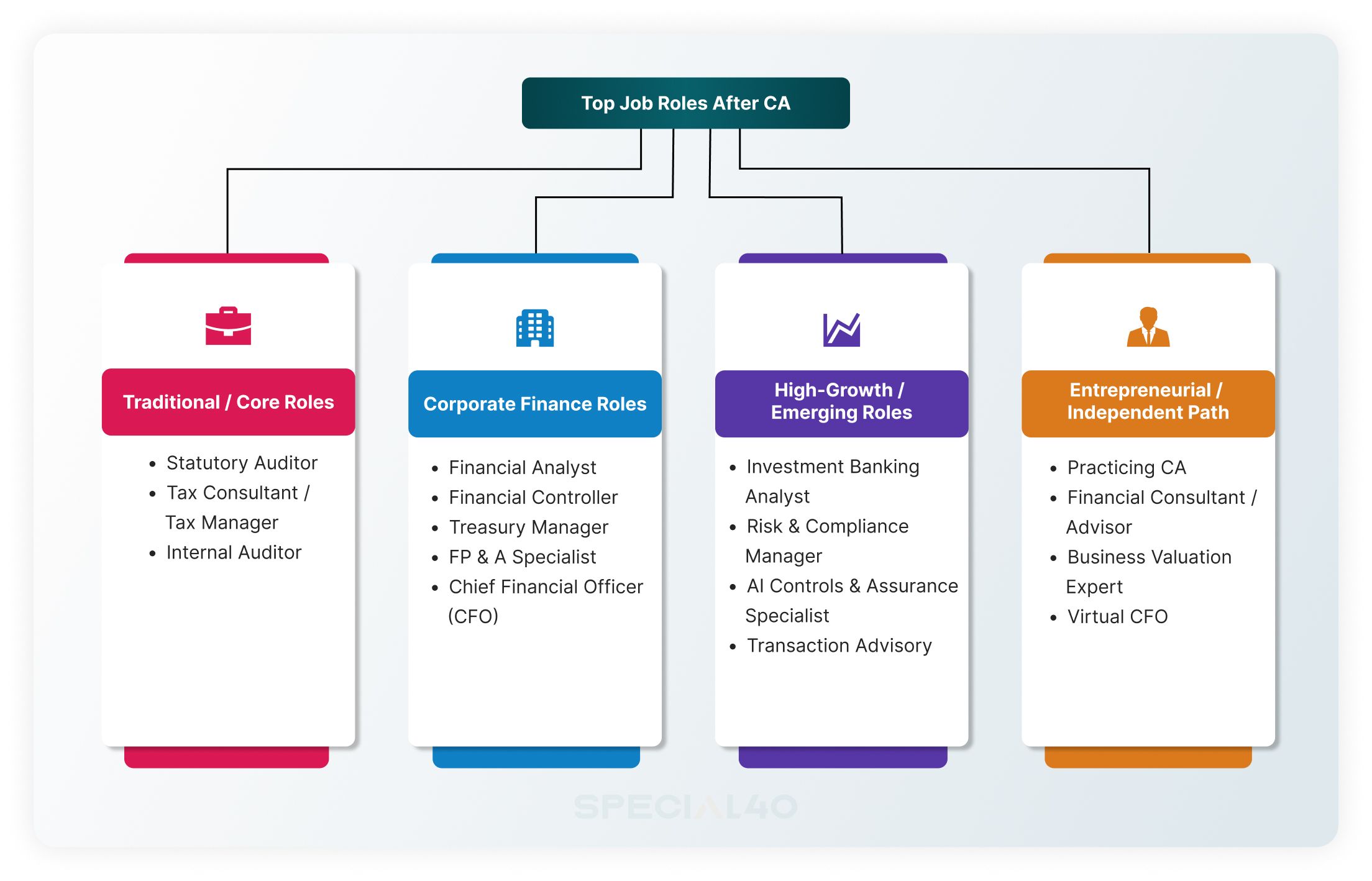
Top Job Roles After CA
Becoming a CA has the benefit of choosing from the diverse CA jobs in India. Different jobs for Chartered Accountants are available in India in various domains within the finance and business sector.
Here you will find different career opportunities Chartered Accountants can choose from.
Traditional / Core Roles
Traditional CA roles are career options for CAs that are always in demand. These roles are necessary for every organisation. If you want to pursue a familiar and stable career in finance, these jobs are ideal.
Statutory Auditor - Review financial statements for accuracy and regulatory compliance, typically within audit firms or corporate internal audit teams.
Tax Consultant / Tax Manager - Advisor for businesses on direct and indirect tax planning, compliance, and litigation support.
Internal Auditor - Evaluate internal controls, risk management, and governance processes within an organization.
Corporate Finance Roles
Corporate Finance roles are ideal for those who want broader business exposure. In corporate finance, like in MNCs, businesses deal with complex financial and strategic business challenges, giving opportunities for CAs to gain expertise. The most common CA career options in corporates are given below:
Financial Analyst - Analyze financial data to guide business decisions, budgeting, and forecasting.
Financial Controller - Oversees an organization's accounting operations, financial reporting, and internal controls.
Treasury Manager - Manages company cash flow, investments, working capital, and financial risk.
FP & A Specialist - Focuses on Budgeting, forecasting future revenues, and evaluating business performanceChief Financial Officer (CFO) - Leads the company’s financial strategy and oversees key financial and business decisions.
High-Growth / Emerging Roles (2026 Focus)
As the finance industry evolves, work structures, technology, and business practices are changing rapidly. This creates a huge demand for graduates with stronger technical and analytical skills, opening doors for new and emerging career opportunities for qualified professionals.
Investment Banking Analyst - Supports mergers and acquisitions (M&A), capital raising, financial modelling, and company valuations.
Risk & Compliance Manager - Identifies financial and regulatory risks and ensures the organisation complies with applicable laws and regulations.
Forensic Accountant / Fraud Analyst - Investigates financial irregularities, fraud, and suspicious transactions to uncover financial misconduct.
ESG & Sustainability Reporting Analyst - Tracks ESG performance and prepares sustainability reports to meet regulatory and stakeholder requirements.
Finance Data & Automation Specialist - Combines finance and technology to improve financial processes by using automated data to build forecasting models, automate reporting, and enhance financial decision-making.
AI Controls & Assurance Specialist - Ensures the reliability of AI-driven automation by identifying errors and designing controls around AI usage.
Transaction Advisory/Due diligence - Evaluate businesses by analysing their financials, identifying key risks and opportunities, and supporting clients in making informed investment and transaction decisions.
Entrepreneurial / Independent Path
On one hand, many finance experts reap the corporate benefits, and on the other, some avoid the corporate ladder to build something of their own. An independent path or entrepreneurial role can be achieved through these jobs after CA.
Practicing CA - Running an independent practice offering audit, tax, and advisory services.
Financial Consultant / Advisor - Offering personalized financial planning and advisory services to individuals or businesses.
Business Valuation Expert - A specialized, high-value niche supporting M&A, litigation, and fundraising valuations.
Virtual CFO - Outsourcing CFO services, including financial planning, cash flow management, budgeting, forecasting, MIS, and performance of the organization.
These independent career paths are in demand at consulting and business advisory firms like Capitaire, where CAs can work on financial strategy, valuations, business transformations, and growth advisory.
Salary Insights by Role & Experience
Salary is often the single biggest driver of career decisions. CAs get one of the most competitive salaries in India.
High-paying jobs after CA are mostly in senior finance roles. However, the salary of a Chartered Accountant in India varies within the industry; for example, Big 4 firms often pay less for entry-level roles, while startups, investment firms, and specialised finance roles can offer higher compensation.
As experience in your role grows with responsibility and decision-making, so does your earning potential. As your role, decision-making authority, and responsibilities grow, so does your earning potential.
In addition, specializing in specific international tax, forensic accounting, or data-driven finance roles may help finance graduates earn premium pay due to the scarcity of expertise in these advanced roles.
Also, add-on certifications like CFA, CPA, ACCA, and others frequently push salary margins higher by 15-30%. Salary packages may also increase significantly in top-tier cities compared to tier-two cities for the same roles.
Industries Actively Hiring CAs in 2026
Every year, several industries hire finance graduates, especially CAs, in different roles ranging from traditional accounting and banking roles to strategy and risk across various finance sectors. Here are the top sectors that actively hire CAs.
BFSI (Banking, Financial Services, Insurance) - Consistently hires finance talent across a wide range of roles.
FinTech & Startups - High demand for CAs who can operate lean finance functions and understand digital-first business models.
Big 4 & Consulting Firms - Top talent recruiting firms offering structured growth and global exposure.
Manufacturing & Conglomerates - Strong demand for finance professionals to manage complex operations, large-scale finances, and diverse business functions.
Government / PSU Roles - Competitive recruitment exams offer finance professionals stable careers, attractive benefits, and competitive compensation.
ESG/Sustainability advisory - Growing demand for CAs to support sustainability disclosures, risk assessment, assurance, and ESG reporting in businesses.
The Five Shifts that will reshape CA careers by 2031
As technology and automation reshape the finance industry, the role of Chartered Accountants is evolving beyond traditional accounting. By 2031, five key shifts are expected to redefine CA careers, creating new opportunities in technology, analytics, strategy, and advisory.
1. Auditing Becomes More of a Judgemental Process
While technology can audit every single transaction rather than sampling transactions for audit purposes, it is likely that the work profile of an auditor would evolve into becoming more judgemental. Therefore, in the future, there would be a need to understand and interpret the situation in the organisation better, rather than conducting testing and audits of figures.
2. Compliance Becomes Routine, Advisory Gains Value
The work related to basic compliance, tax filings, and reconciliations may become largely automated, while advisory services like interpreting notices, dispute resolution, and decision-making would become more relevant. Therefore, in the future, there is a lot of scope for shifting from the preparation aspect of compliance towards advisory.
3. GCCs Will Be a Primary Choice of Careers for CAs
GCCs are becoming increasingly responsible for controllership, FP&A, Treasury, Tax, and even Internal Audit roles. As a result, CAs will have the opportunity to get international experience through GCCs without having to leave India. Therefore, CAs should focus equally on soft skills like communication, stakeholder management, and technology, in addition to accounting.
4. Sustainability Reporting Puts CAs in Demand
As businesses begin to disclose not only financial but also their sustainability and social performance information, there is a need for verification and audit of this information. Therefore, CAs have a huge opportunity to do the assurance of non-financial information of the companies.
5. CAs Begin Moving Across Career Tiers
The role of an accountant will likely transition from routine and repetitive tasks, which will become increasingly automated by 2031. On the other hand, there will be increasing demand for roles that require business judgement, advisory, technology, deals, forensics, and assurance. Therefore, building specialised future-ready skills would help CAs move up the career tiers.
Skills to Add for Career Acceleration today & in future
CA qualification alone won't maximise your chances of getting employed in high-paying roles. Industry-relevant skills and practical knowledge are critical to perform effectively.
1. Technical Skills
Financial modelling, advanced Excel, Power BI, data analytics, and financial reporting. These skills can be gained through online courses, practical projects, and hands-on experience.
2. Global & Professional Certifications
CFA, CPA, ACCA, FRM, DISA, CISA, and CIA can strengthen your expertise for specialised career paths. Obtain these certifications based on where you want to work and in which role.
3. Soft Skills
Develop leadership, communication, problem-solving, cross-functional collaboration, and stakeholder management skills through Special40’s career accelerator program or from team projects, presentations, and client-facing roles.
4. AI & Automation Skills
AI tools, automation, data-driven forecasting, reporting, and financial modelling are growing.
Gain expertise in AI-focused tools through courses and hands-on experimentation in automation projects
5. Commercial Judgement
Strengthen your ability to understand how businesses make or lose money, optimise pricing for profitability, manage working capital and identify key business challenges and risks. Develop these skills through business case studies and exposure to real-world businesses.
How to Choose the Right Path
The right path for a career in finance cannot be narrowed down to a single factor. It entirely depends on your personal objectives, skills you possess, and what you are passionate about.
When choosing the right finance career, consider these factors:
Work Environment - Do you prefer stability and structure, or a dynamic, fast-changing environment?
Nature of Work - Are you more comfortable with numbers and analysis, or do you enjoy client-facing and relationship-driven roles?
Career Model - Do you prefer the security of employment, or the independence that comes with practice or entrepreneurship?
Career Goals - Are you prioritising short-term income, or building towards long-term growth and leadership roles such as a CFO?
Answering these questions can help you narrow down the right CA career options that align with your strengths, goals, and preferred way of working.
Qualifying for a CA course is not the end of your journey; it is the beginning of your CA professional career. A qualified CA with diverse technical expertise can land a high-paying CA role and build a successful career.
However, the right career path comes down to your personal goals, strengths, and the way you want to work.
You may see yourself in a specialised role, a consulting firm, business leadership, or building an independent practice. Professional qualifications, practical experience, and technology skills can help you move confidently towards the path that fits you best.
The financial landscape is continuously evolving, with technology reshaping the way finance professionals work. Going forward, we can expect new career opportunities in AI, automation, data analytics, and other emerging technologies.
The future of the CA profession will not simply be about competing with technology, but about using it to create greater value, make better decisions, and take on more strategic roles.
FAQ
What are the best career options after CA?
The best career option after CA cannot be narrowed down to one. It depends on personal career goals, skills, passion, and the way you want to work.
What is the highest-paying job after CA?
The highest-paying job in a CA career is in senior roles in top industry firms such as Big 4 companies or other financial institutions.
Can a CA work outside India?
Yes, a CA can work outside India. However, it is essential to understand the local laws, regulations, and professional requirements of the country you plan to work in.
Can a CA work in investment banking?
Yes, a CA can work in investment banking, especially in areas like M&A and transaction advisory, Valuation and financial modelling, Due diligence, Equity/debt capital markets, and Financial analysis
What is the salary of a CA in India?
The salary of a CA in India varies based on experience, role, industry, location, and skills. Broadly, CAs can earn around ₹50,000–₹90,000 per month at entry level, ₹1–₹3.5 lakh at mid to senior levels, and ₹4 lakh+ per month in senior leadership or specialised roles.