

Many finance graduates know that becoming a CA is a long journey and opens doors to diverse career opportunities. But does anyone really know what the course and subjects CA aspirants need to complete on the journey?
CA is one of India's most respected and financially rewarding courses, but it is also one of the toughest courses to crack in one go.
In this CA course guide, we will break down the CA course structure for 2026, including its papers, subjects, exam pattern, and everything you need to know for the three examination stages of the CA course.
This guide will help you prepare and gain clarity so you can stay ahead.
The Three Stages of the CA Course
The three CA examination stages mentioned above are;
CA Foundation Exam - Entry level
CA Intermediate Exam - Intermediate level
CA Final Exam - Final level
From course structure to examination papers, everything is managed and handled by the ICAI.
Earlier, the CA course syllabus consisted of 22 papers in total, distributed across the three levels as follows:
CA Foundation: 6 papers
CA Intermediate: 8 papers
CA Final: 8 papers
However, under the new scheme, ICAI has trimmed the paper count to 16 across the three levels, focusing on more practical application, case studies, and professional expertise rather than just role.
The paper count for each examination under the new scheme is as follows;
CA Foundation: 4 papers
CA Intermediate: 6 papers
CA Final: 6 papers
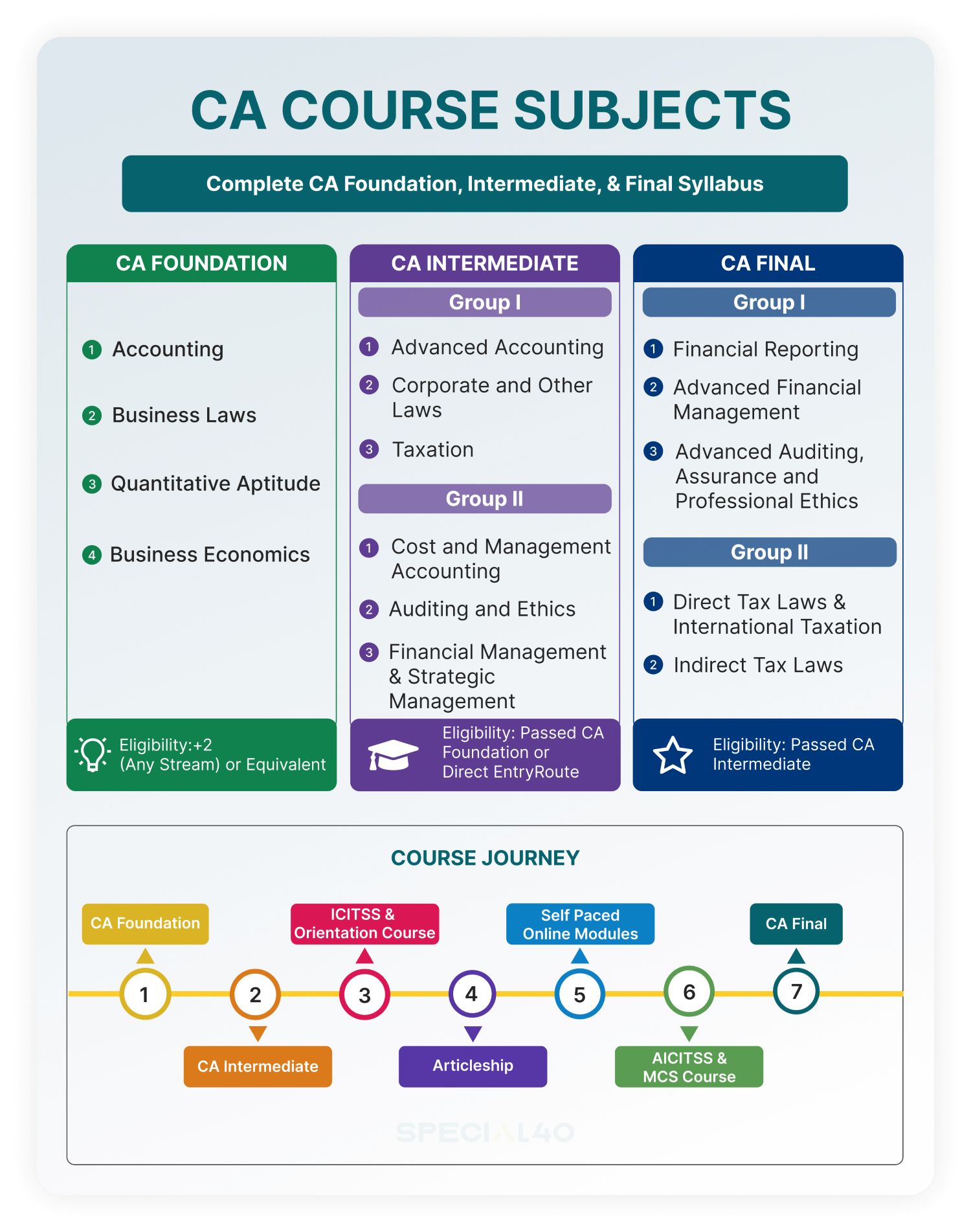
CA Foundation Subjects 2026
Once schooling is completed, finance aspirants can enrol in the CA Foundation course. Here, you will find eligibility, course structure, marks required to pass the foundation exam, and the examination fee.
Eligibility
To become eligible for the CA Foundation Exam, finance aspirants must complete their Class 12 examination regardless of the stream they studied.
CA Foundation Examination eligibility - 12 Pass (Any stream)
Course structure
CA Foundation course structure involves completing 4 papers. The name of the subject, its type of examination, and the marks required to qualify are given below.
Paper | Subject | Type |
Paper 1 | Accounting | Subjective |
Paper 2 | Business Laws | Subjective |
Paper 3 | Quantitative Aptitude (Business Mathematics, Logical Reasoning & Statistics) | Objective (MCQ) |
Paper 4 | Business Economics | Objective (MCQ) |
Paper 1: Accounting
The first paper in the CA Foundation exam is Accounting, which will be conducted as a subjective test. The paper primarily covers basic accounting, bookkeeping, and fundamental accounting concepts, helping students build a strong foundation in basic accounting skills.
Paper 2: Business Laws
The second examination is focused on the paper Business Laws, which is also conducted as a subjective test. Business Laws paper focuses on business and corporate laws, helping students to understand legal principles and regulations relevant to business operations.
Paper 3: Quantitative Aptitude (Business Mathematics, Logical Reasoning & Statistics)
Unlike Papers 1 and 2, the Quantitative aptitude test is an MCQ-based objective examination, with negative marking of 0.25 for incorrect answers. It is mainly focused on Business, Mathematics, Logical Reasoning, and Statistics. It helps students develop critical thinking and logical reasoning from a business perspective.
Paper 4: Business Economics
The final paper in the CA Foundation exam, Business Economics, is also an MCQ-based objective examination, with a negative marking of 0.25 for incorrect answers, that solely covers Business Economics and its fundamental concepts and principles.
Exam Schedule
As we have learned, the CA Foundation examination consists of four papers, each conducted on a different date. The examinations are conducted in the months of January, May, and September.
The examinations are generally scheduled with a gap between papers. In addition to these planned gaps, weekends and public holidays may also fall between examination dates, resulting in longer intervals between certain papers. This can give students additional time to revise and prepare for the upcoming examination.
Passing Criteria
Qualifying CA exams are unlike other degree courses. In CA exams, it is not enough that individuals qualify for each exam separately.
CA Foundation passing criteria: Candidates need at least 40% in each paper and 50% aggregate across all four papers.
Examination Fee
Finance graduates and aspirants can apply for the CA Foundation examination by registering and paying a fee of ₹9,000, and the exam fee is 1500
CA Foundation Registration fee: ₹9,000
CA Intermediate Subjects 2026
CA Intermediate examination is the second stage of the CA course. Unlike the foundational exam, the CA Intermediate exam is structured around advanced finance topics. Here, you will find every detail about the CA Intermediate examination
Eligibility
To appear in the CA Intermediate examination, candidates must qualify the CA examination as per the passing criteria.
CA Intermediate Examination eligibility - Must qualify the CA Foundational Examination
Course structure
CA Intermediate exam course has six papers categorized into two groups. More details about the course subjects, fees, and passing criteria are given below:
Group I
Paper | Subject | Type |
Paper 1 | Advanced Accounting | 70 % Subjective & 30% Objective |
Paper 2 | Corporate and Other Laws | 70 % Subjective & 30% Objective |
Paper 3 | Taxation Section A: Income-tax Law Section B: Goods and Services Tax | 70 % Subjective & 30% Objective |
Group II
Paper | Subject | Type |
Paper 4 | Cost and Management Accounting | 70 % Subjective & 30% Objective |
Paper 5 | Auditing and Ethics | 70 % Subjective & 30% Objective |
Paper 6 | Financial Management & Strategic Management Section A: Financial Management Section B: Strategic Management | 70 % Subjective & 30% Objective |
Paper 1: Advanced Accounting
The first paper in Group 1 is Advanced Accounting, focused on advanced accounting topics, which is built upon the fundamental topics learned at the foundation level. It focuses on the application of accounting standards, preparation of financial statements & accounting treatments relevant to different business situations.
Paper 2: Corporate and other laws
Corporate and Other Laws is the second paper. It mainly covers the fundamentals and principles of the Companies Act, 2013, the Foreign Exchange Management Act, 1999, and the General Clauses Act, 1897, and other corresponding laws relevant to the legislation.
Paper 3: Taxation (Income Tax Law & Goods & Services Tax)
The final paper of Group Three is taxation. Taxation is further structured into two modules
Income Tax Law; and
Goods & Service Tax
The examination is conducted on a single paper covering these two topics. This paper helps students understand basic concepts of Income Tax Law, the taxation of different sources of income, and key aspects of GST, including tax invoices and related provisions.
The second group of papers in the Intermediate exam also consists of three papers: Cost and Management Accounting, Auditing and Ethics, and Financial and Strategic Management
Paper 4: Cost and Management Accounting
Cost and Management Accounting paper mainly covers the basics of cost association with products and services. Additionally, it includes employee cost structuring, integration of cost and data, costing methods, cost control and analysis, budgeting, and budgetary control.
Paper 5: Auditing and Ethics
The second paper in the CA Intermediate exam is Auditing and Ethics. This paper delves deep into Auditing concepts such as Audit planning, strategy, risk assessment, audit documentation, and many others.
Paper 6: Financial & Strategic Management
The final paper, Financial & Strategic Management, explores both Financial and strategic management concepts. It is categorised into two sections.
Financial Management includes financial analysis through ratios, financing decisions, capital cost management, capital investment decisions, and working capital management.
The strategic management subject covers internal and external strategic analysis, strategic implementation, evaluation, and other topics.
Exam Schedule
Similar to the CA Foundation exam, the examination is conducted in January, May, and September. With six papers, the exams are conducted group-wise, with Group 1 papers held first, followed by Group 2 papers.
For more details about the CA Intermediate syllabus, visit the official ICAI website.
Passing Criteria
Qualifying the CA Intermediate exam is harder than the foundation exam. Each subject follows a 70% subjective and 30% objective. Candidates need 40% in each paper and 50% aggregate per group to clear that group.
CA Intermediate passing criteria: Needs at least 40% and 50% aggregate per group.
Examination Fee
After completion of the CA Foundation exam, candidates can apply for the CA Intermediate exam by registering and paying an application fee of ₹18,000, while the exam application form fee is ₹2,700 for both groups or ₹1,500 for a single group.
Exam Registration Fee: 18000
Self-Paced Online Modules
After passing both groups of the CA Intermediate exam and before appearing for your CA Final examinations, candidates should appear for Self-Placed online Modules, which are computer-based tests (CBT). Candidates can attend the exam by applying for it and paying a prescribed fee as given on the official website.
Eligibility
Candidates must pass the CA intermediate exam to appear for Self-Paced Online Modules.
Course structure
Self-Paced Online Modules (SPOM) cover a vast course curriculum, which is divided into 4 Sets. Below, you will find the courses offered under each set, along with the respective requirements and marks.
Set A: Corporate and Economic Laws (100 marks)
Part I : Corporate Laws (70 marks)
Section a : Company Law (50 marks)
Section B : Securities Laws (20 marks)
Part II : Economic Laws (30 marks)
Set B: Strategic Cost & Performance Management (100 marks)
Part I: Strategic Cost Management
Part II: Strategic Performance Management
Part III: Case Study
Set C: Students must choose one paper from these options, which carries 100 marks.
Paper-1: Risk Management
Paper-2: Sustainable Development and Sustainability Reporting
Paper-3: Public Finance and Government Accounting
Paper-4: The Insolvency and Bankruptcy Code, 2016
Paper-5: International Taxation
Paper-6: The Arbitration and Conciliation Act, 1996
Paper-7: Forensic Accounting
Paper-8: Valuation
Paper-9: Financial Services and Capital Markets
Paper-10: Forex and Treasury Management
Set- D: Students must choose one paper from these options, which carries 100 marks.
Paper-1: The Constitution of India & Art of Advocacy
Paper-2: Psychology & Philosophy
Section A: Psychology
Section B: Philosophy
Paper-3: Entrepreneurship & Start-up Ecosystem
Paper-4: Digital Ecosystem and Controls
Exam Schedule
There is no specific date for the examination. Once the mandatory 40 hours is completed, candidates can appear for the computer-based test.
Passing Criteria
Candidates require at least 50% of the marks to qualify for this examination.
Examination Fee
Candidate need to pay an examination fee when you register for the corresponding Self-Paced Module Tests (SPMT) ₹500 per paper for test centers in India.
Information Technology Training & Soft Skills Course
Information Technology Training & Soft Skills (ITTSS) course is divided into two;
Integrated Course on Information Technology and Soft Skills (ICITSS)
Advanced Integrated Course on Information Technology and Soft Skills (AICITSS)
Integrated Course on Information Technology and Soft Skills (ICITSS)
This is a mandatory training program to equip candidates with IT and soft skills. The course duration is four weeks, structured into two parts
Orientation - 15 Days
Information Technology - 15 Days
Eligibility
After completion of intermediate exams, it is mandatory to complete the Integrated Course on Information Technology and Soft Skills before joining practical training.
Orientation Course
The orientation course aims to upskill candidates in various dimensions of the Indian Accountancy profession.
It helps;
• To develop effective communication and presentation skills.
• To groom and motivate the entrants to be knowledgeable and skilled professionals.
• To expand the significance of practical training in the life of a professional.
• To foster values such as integrity, transparency, and Independence in the budding professionals.
Course Schedule: Course duration is 15 working days, scheduled for 6 hours per day.
Course Fee: To appear in the orientation course of ICITSS, candidates must pay a fee of ₹7,000.
Course on Information Technology
The Information Technology course aims to equip candidates with the necessary knowledge and skills to effectively use Information Technology tools in the fields of accounting and auditing.
It helps;
• To develop an understanding of Information Technology tools used in accounting and auditing.
• To provide uniform theoretical and practical knowledge to aspiring CA students.
• To enhance the practical application of Information Technology in professional activities.
• To prepare candidates for the effective use of technology during their practical training.
Course Schedule: The course is scheduled for 15 working days, with classes conducted for a minimum of 6 hours per day.
Course Fee: Candidates must pay a fee of ₹6,500 to complete the Information Technology course.
Additionally, an examination based on the curriculum of Information Technology is conducted to test the ability of the student. Candidates can appear for the exam after completing the course.
Articleship
Articleship is a CA practical training program that is mandatory for every candidate before appearing for the CA Final examination. It is necessary that the articleship be completed under the guidance and supervision of a qualified and practicing Chartered Accountant.
Eligibility: Candidates can appear for the articleship program after completing the CA Intermediate examination and the Integrated Course on Information Technology and Soft Skills (ICITSS).
Duration: The duration of the articleship training program is 2 years.
Fee: A fee of ₹2000 is mandatory for Articleship registration.
Information Technology Training & Soft Skills Course
As we have earlier discussed IT courses, here are more details about the advanced IT course for CA aspirants.
Advanced Integrated Course on Information Technology and Soft Skills (AICITSS)
The Advanced Integrated Course on Information Technology and Soft Skills (AICITSS) is a mandatory training program to equip candidates with advanced IT and management and communication skills. The course consists of two parts:
Advanced Information Technology (Advanced IT) – 15 Days
Management & Communication Skills (MCS) – 15 Days
Eligibility: After completion of the practical training period, students who have undergone only one of the GMCS, GMCS-II, or MCS courses under the Final (old) course are required to undergo the remaining component of Advanced ICITSS (MCS).
Management & Communication Skills Course (MCS)
The Management & Communication Skills Course aims to equip candidates with essential skills required to enter and succeed in the profession.
It helps;
• To sharpen communication and presentation skills.
• To develop interpersonal and leadership skills.
• To provide an understanding of the contemporary business environment and opportunities.
• To prepare candidates for a career in employment or practice by developing adaptability and accountability.
Course Schedule: The course is scheduled for 15 working days, with classes conducted for 6 hours per day.
Course Fee: Candidates must pay a fee of ₹7,000 to complete the Management & Communication Skills course.
Course on Advanced Information Technology
The Advanced Information Technology course aims to develop practical skills in auditing ERP environments by understanding their complexities through Information Technology and Data Analysis.
It helps;
• To develop practical skills in auditing ERP environments.
• To understand and analyse complex IT environments using relevant tools.
• To develop familiarity with audit and data analysis tools such as Python, KNIME, Power BI, ZOHO, Oracle Fusion, and MS Dynamics.
• To enhance the practical application of technology in auditing and professional activities.
Course Schedule: The course is scheduled for 15 working days, with classes conducted for a minimum of 6 hours per day.
Course Fee: Candidates must pay a fee of ₹7,500 to complete the Advanced Information Technology course.
CA Final Subjects 2026
CA Final is the last major exam in the CA course. It has a deeper and more advanced curriculum than CA Intermediate.
Eligibility
Upon completion of the CA articleship program and ITTSS courses, the candidate can appear for the CA Final examination.
CA Final Examination eligibility: Must complete the Articleship program and IT Training & Soft Skill Course
Course structure
CA Final exam course has six papers divided into two groups. Each group has three papers. Subjects and what is covered under these papers are given below.
Group I
Paper | Subject |
Paper 1 | Financial Reporting |
Paper 2 | Advanced Financial Management |
Paper 3 | Advanced Auditing, Assurance and Professional Ethics |
Group II
Paper | Subject |
Paper 4 | Direct Tax Laws & International Taxation |
Paper 5 | Indirect Tax Laws Part I: Goods and Services Tax Part II: Customs & FTP |
Paper 6 | Integrated Business Solutions (Multidisciplinary Case Study with Strategic Management) |
Paper 1: Financial Reporting
This paper covers advanced financial reporting concepts, accounting standards, and the preparation and presentation of financial statements in accordance with the applicable framework.
Paper 2: Advanced Financial Management
The second paper in the final course covers advanced concepts in making financial decisions, investment strategies, risk management, and corporate financial planning.
Paper 3: Advanced Auditing, Assurance and Professional Ethics
The final paper in the first group, Advanced Auditing, Assurance, and Professional Ethics, focuses on advanced auditing and assurance practices along with professional accounting standards and ethical requirements that guide the responsibilities & conduct of chartered accountants.
Paper 4: Direct Tax Laws & International Taxation
Direct Tax Laws & International Taxation covers the principles and application of direct tax laws, including computation of taxable income, tax liability, and the key concepts of international taxation.
Paper 5: Indirect Tax Laws (Goods & Services Tax and Customs & FTP)
Indirect Tax Laws are taxes that are paid indirectly. This paper covers indirect taxes under Goods and Services Tax and Customs & FTP. The paper is divided into two.
This paper covers one concept in two different applications: indirect and direct taxes based on the Goods & Services Tax (GST), and Customs and Foreign Trade Policy. These two concepts mainly cover the legal framework, compliance requirements, and practical application of indirect taxes.
Paper 6: Integrated Business Solutions (Multidisciplinary Case Study with Strategic Management)
This is a multidisciplinary case study-based examination that integrates concepts from different areas of the CA curriculum, providing students with skills and practical experience to apply their abilities to real-world business situations.
Examination Schedule
The examination schedule is similar to both the foundation and intermediate exams. While other exams are held three times a year, the CA final exam is conducted only twice a year, in May and November.
Passing Criteria
Passing criteria for the CA final exam are similar to those of the Intermediate exams.
Passing Criteria: Every candidate needs 40% in each paper and a 50% aggregate per group to qualify.
Examination Fee
Candidates can appear for the CA Final examination by paying a registration fee of ₹22,000 and exam fee ₹1500 per group or both groups ₹2700.
Exam Registration Fee: 22000
CA Foundation vs Intermediate vs Final: Quick Comparison
Aspect | Foundation | Intermediate | Final |
|---|---|---|---|
Number of papers | 4 | 6 (2 groups) | 6 (2 groups) |
Total marks | 400 | 600 | 600 |
Passing criteria | 40% per paper, 50% aggregate | 40% per paper, 50% per group | 40% per paper, 50% per group |
Exam frequency | 3 times a year | 3 times a year | 2 times a year |
Difficulty level | Entry-level | Intermediate | Advanced |
Core focus | Fundamentals | Application + law + taxation | Strategy, reporting, ethics |
How Long Does the Full CA Course Take?
As we have understood, becoming a CA is a long journey involving examinations, preparation, and e-learning. The time taken to complete the full CA course may vary based on an individual's pace and number of attempts.
The CA journey can be planned early by preparing alongside Class 12 to become a CA at an early age. Those who start after Class 12 or even after getting a degree can also follow the same journey.
Completing the course in one go may take around 4½ to 5 years, considering the examination schedule, preparation time, and articleship.
For students who wish to start early and plan their CA journey alongside Class 12, here is a detailed timeline to follow:
Start Preparation alongside Class 12
↓
CA Foundation — May (Year 1)
↓
CA Intermediate Preparation — May to December (8 months)
↓
CA Intermediate — January (Year 2)
↓
SPOM + ICITSS (2 Months)
↓
Articleship — May (2 Years)
↓
AICITSS — June (1 Month) Year 4
↓
CA Final Preparation — July to May (10 Months)
↓
CA Final
↓
Chartered Accountant
Also Read: Salary of a Chartered Accountant in India
The CA course is a long journey for individuals who aspire to excel in the finance industry as a CA. Clearing the journey in one go is extremely hard, considering the vast subjects covered in the CA Foundation, CA Intermediate, and CA Final exams.
Along with the examinations, candidates are also required to complete Self-Paced Online Modules, Information Technology and soft skills programmes, and articleship. To become excellent in these self-paced and soft skills programs, along with other core topics in CA, candidates can explore Special 40’s practical and accounting training programs to become ready.
For updated information about the curriculum, examination dates, schedules, fees, and other CA course details, candidates must go to the ICAI's official website.
FAQ
Is CA difficult or easy?
Generally, the CA course is considered difficult, considering the vast and in-depth finance curriculum. However, it is not impossible. If graduates follow a structured study plan, strengthen core subject learning, and consistently prepare, they can successfully complete the CA exams.
What is a CA's monthly salary? (link to CA salary blog)
An average CA’s monthly salary in India for top CA roles is around ₹6-8 lakhs.
How to apply for CA?
Any aspiring finance graduate who has completed Class 12 can apply for CA through the official ICAI website.
Can I study CA after 12th Commerce? (link to how to become a CA after 12 blog)
Yes, commerce students can study and become a CA after 12. Candidates must stay updated on the official website for registration and exam updates.
How long does the CA course take?
To complete the CA course, it may take around 4 ½ to 5 years to complete the CA course and pursue a successful CA career.
Can I skip CA Foundation and go directly to Intermediate?
Yes. Commerce, non-commerce, and other graduates/postgraduates meeting ICAI's eligibility criteria can enter through the direct-entry route, bypassing Foundation.
How many times a year are CA exams conducted?
CA Foundation and CA Intermediate examinations are conducted three times a year in the months of January, May, and September. CA Final examination is conducted two times a year, in May and November.
What are the passing criteria for CA exams?
The passing criteria for all the CA exams is, candidates must score 40% in each subject and 50% aggregate in all the papers per group.