

"We earned a profit of ₹40 lakhs. Why are we unable to pay salaries this month?"
This is one of the most common questions asked in many companies. And the only way to find the answer to this question is through the interpretation of financial statements, P & L Account and Balance Sheet based on which cash flows are analysed.
While P & L accounts show the financial performance of a business during a certain period of time, the Balance Sheets shows the financial condition of a business on a particular day.
Consider the P & L accounts as the video recording of financial performance of any business and the Balance Sheets as the photograph of the financial position of any business.
Software such as TallyPrime and Zoho Books can produce both of these reports in a matter of seconds.However, knowing how to interpret the numbers is an important skill for accounting professionals.
In the case of financial statements for B.Com students, one must learn about the difference between profit and loss account vs balance sheet. So, let's explore what a P&L Account and Balance Sheet tell us about a business and how they differ from each other.
What Is a Profit and Loss Account?
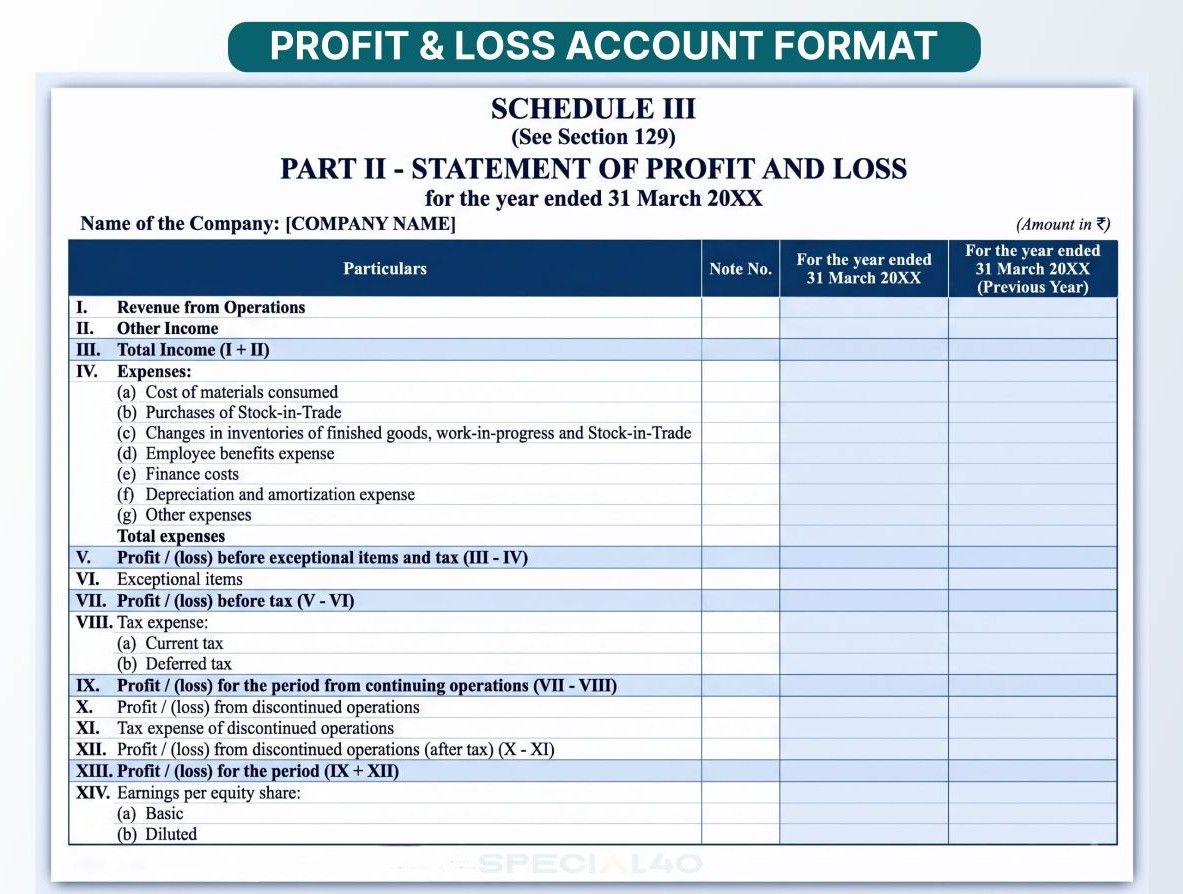
The Profit and Loss Account is also called Income Statement or Statement of Profit and Loss. It gives details of all income and expenditure of a business during a certain period of time. This report helps in identifying whether the business is making a profit or loss.
Major Components:
Revenue: Income made through sales or services.
Cost of Goods Sold (COGS): Cost associated with production or purchase of the goods sold.
Gross Profit: The amount left after deducting the COGS from revenue.
Operating Expenses: Rent, salary, power, and marketing costs.
Operating Profit: Profit from usual activities of a business without considering interest and taxes.
Net Profit: Profit after deduction of all expenses, interest and taxes.
Net Profit = Total Revenue − Total Expenses
For example, if a bakery earns ₹1 crore in revenue and has ₹60 lakh in direct expenses, then the gross profit earned would be ₹40 lakh, which is equivalent to a gross margin of 40%. If the margin falls to 32%, the business may need to investigate rising raw material costs, wastage or pricing. This is the reason why the gross profit is analyzed by the business owner and finance professionals before considering the net profit.
Line | What it means | Example: a bakery |
Revenue | Sales of goods or services during the year | ₹1,00,00,000 of bread, cakes and snacks sold |
Cost of Goods Sold (COGS) | Direct cost of making or purchasing the products sold (Raw material, production wages, factory power costs) | Flour, sugar, butter, baker wages: ₹60,00,000 |
Gross Profit | Revenue minus COGS. Shows how profitable the product itself is | ₹40,00,000 (40% gross margin) |
Operating expenses | Costs of running the business: rent, staff salaries, marketing, electricity, depreciation | ₹25,00,000 |
Operating Profit (EBIT) | Profit from the core business, before interest and tax | ₹15,00,000 |
Interest & tax | Finance cost on loans, income tax | ₹5,00,000 |
Net Profit | The profit left after deducting all costs, interest, and taxes. | ₹10,00,000 |
What Is a Balance Sheet?
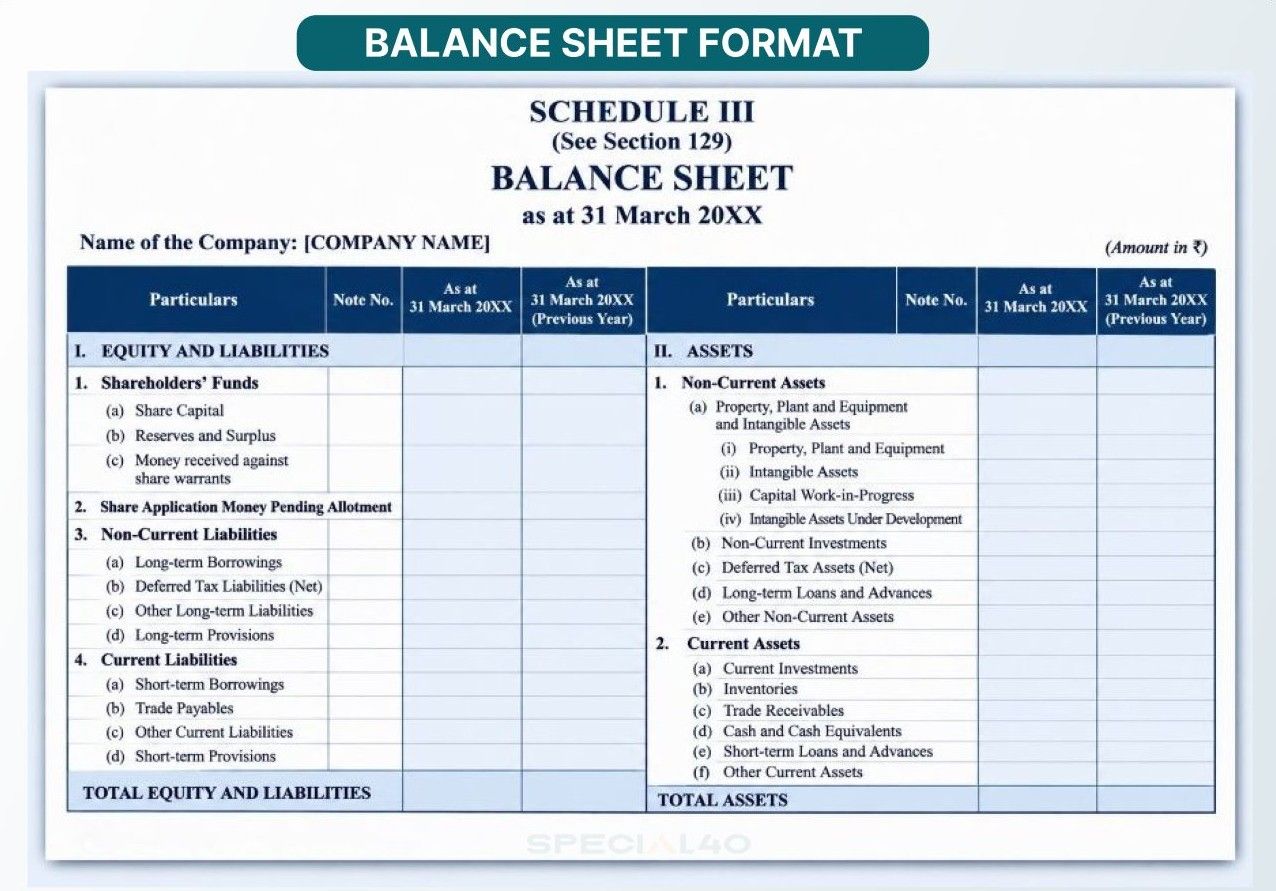
A Balance Sheet is a document showing the financial status of an organization at a certain point in time. It highlights what the organization possesses, owes to others, and the financial stake of the owners in the organization.
Three Major Components:
Assets: It includes all those things that the company owns or controls. For example, cash, bank balance, inventory, machinery, and building.
Liabilities: Liabilities include the loans taken from the bank, the amounts payable to the supplier, outstanding expenses, and more.
Equity: After subtracting the liability from assets, it will be called the equity of the owner.
The Accounting Equation is:
Assets = Liabilities + Equity
For example, when the value of assets is ₹10 Lakhs and that of liabilities is ₹4 Lakhs, then the equity of the firm shall be ₹6 Lakhs.
According to Schedule III of the Companies Act, 2013, the Balance Sheet of a company is presented in a vertical manner with current and non-current items. The proprietorship and partnership firms can also follow the T-format.
Profit and Loss Account vs Balance Sheet: Key Differences
Knowing the difference between the Profit and Loss Account and Balance Sheet can help one to identify the two important aspects of a business’s finances. While both are crucial financial documents, they differ in their uses and compositions. A Comparison of Income Statement vs Balance Sheet is vital to anyone studying accounting.
Feature | Profit and Loss Account | Balance Sheet |
Purpose | Measures profitability | Shows financial position |
Timeframe | Covers a specific period E.g. 1 April -31 March | Shows a specific date E.g. 31 March |
Components | Income and expenses | Assets, liabilities and equity |
Main Formula | Revenue − Expenses | Assets = Liabilities + Equity |
Nature of Accounts | Nominal accounts (Revenues & Expenses) | Real & Personal accounts (Assets, Liabilities, Equity) |
Main Question it answers | Is the business profitable? | What does the business own and owe? |
Year-End Treatment | Closed, starts from zero next year | Balances are carried forward |
In simple terms, the P&L measures business performance, while the balance sheet reveals its financial position.
How Does Profit & Loss Statement Relate to the Balance Sheet?
Profit and loss in the Profit and Loss Statement influence the equity section of the Balance Sheet. If profit is generated, then equity is increased; otherwise, it is reduced.
For instance, let us take a business that sells things in the market, and which has capital of ₹3,00,000 at the beginning. Its net profit earned during the period is ₹1,00,000, and there is no drawing.
Beginning capital: ₹3,00,000
Net profit: ₹1,00,000
Ending equity: ₹4,00,000
With the assets of ₹6,00,000 and liabilities of ₹2,00,000, the Balance Sheet would show an equity of ₹4,00,000.
This explains how profit and loss links to the balance sheet.
Practical Accounting Entries Beginners Should Understand
Understanding the trading and profit and loss account is not enough. Accounting professionals must also learn how everyday transactions affect both of these statements.
Transaction | P&L Impact | Balance Sheet Impact |
Loan EMI of ₹50,000 (₹15,000 interest & ₹35,000 principal) | ₹15,000 interest is an expense | Loan reduces by ₹35,000 |
Machinery purchase of ₹5,00,000 | No immediate purchase expense | Fixed assets increase |
Depreciation | Recorded as an expense | Asset’s net value goes down |
GST input credit of ₹18,000 | Not an expense, where credit is available | Shown as an asset until set off |
Closing stock of ₹2,00,000 | Reduces cost of goods sold | Shown as inventory |
Owner's personal withdrawal of ₹30,000 | Not an expense | Reduces owner's capital |
Advance income tax | Not yet an expense | Shown as an asset until adjusted |
The above examples prove that understanding accounting entries is more important than merely memorizing their meanings.
Can a Business be Profitable and Still Have No Cash?
Yes. This is one of the most important concepts in accounting basics for beginners.
Now, let’s look at the details of a distributor:
Particulars | Effect on Cash |
Net profit | +₹12,00,000 |
Increase in customer dues | -₹8,00,000 |
Increase in inventory | -₹6,00,000 |
Loan principal repaid | -₹4,00,000 |
Net change in cash | -₹6,00,000 |
Despite the fact that the company earned a profit of ₹12 lakh, there has been a reduction in cash of ₹6 lakh because the cash was being utilized for settling the liabilities to the customers along with expenses on the inventory and loan repayments.
All these things cannot be deciphered by simply analyzing the P&L account. You must consider the changes that took place in the Balance Sheet between two dates. This is why there exists the third type of statement called the Cash Flow Statement. It helps to recognize the missing links by showing the cash movements from operating, investing and financing activities.
How Professionals Read Financial Statements
In reality, no one goes through the financial statements line by line. Different people will read them with different intentions and look for different information.
Person reading | What they look for | Why |
Business owners | Gross margin, debtor days | Is my product profitable? Are people paying on time? |
Banker | Current ratio, Debt-to-equity | Can this company pay back the loan it needs? |
Investor | Return on equity, net margin, profit growth | Is my money earning a good return? |
Tax/Audit team | Unusual expenses, related-party transactions | Are the figures accurate and accounted for properly? |
Four useful ratios to learn:
Gross Margin = Gross Profit ÷ Revenue × 100
Current Ratio = Current Assets ÷ Current Liabilities
Debt-to-Equity Ratio = Total Borrowings ÷ Equity
Debtor Days = Trade Receivables ÷ Revenue × 365
Such indicators incorporate data from both reports and assist professionals in making better financial decisions.
Why It's Important for Your Finance Career
The employers expect accounting freshers to know more than just definitions. The interviewer may ask about the placement of the closing stock, effect of depreciation in accounting statements or the reasons why the loan EMI is not considered as a total expense.
In case of asking a question like "What is the difference between P&L and Balance Sheet?", a proper response would be like the following:
"The P&L statement gives information about income, expenses and profits or losses made by the business for a certain period of time. "Balance sheet provides details about the assets, liabilities, and capital at a specific point in time. Both statements are related to each other since the net profit or loss impacts the equity portion of the balance sheet."
This understanding helps you to undertake real accounting responsibilities easily.
Common Mistakes Beginners Make
1. Mistaking profit as cash- The distributor case study has proved that profit and cash flow are sometimes on the opposite sides.
2. Mixing up period and date- The P&L statement is for a certain period. The Balance Sheet is a snapshot on a particular date. To write “Balance Sheet for the year ended 31 March” is incorrect; the proper way is “as at 31 March.”
3. Mistaking capital expenditure as an expense- Purchase of machinery is an asset. Depreciation of the machine only will count as an expense.
4. Considering the loan EMI as an expense- Only the interest is an expense and the principal reduces liability.
5. Ignoring the influence of closing stock on both the financial statements- Closing stock reduces the cost of goods sold in the P&L and increases assets in the Balance sheet.
How Special40 Helps You Develop Practical Accounting Skills
Special40 is a CA-led Finance Career Accelerator program that enables commerce students and future finance professionals to acquire practical and job-oriented skills.
The learners will be provided exposure to practical accounting, financial statement preparation, Advanced Excel, Tally Prime, Zoho books, GST & Taxation. The course emphasizes the recording of business transactions, financial statement preparation, financial ratio analysis, and practical accounting cases.
Are you looking forward to acquiring practical finance skills and moving ahead from theoretical accounting? Join Special40!
Final Thoughts
Profit and Loss account shows you the performance of the company whereas Balance Sheet reveals the financial standing of the company. None of these accounts gives you the entire picture.
Understanding both statements, their connection and the impact of everyday transactions will help you build a strong foundation in accounting and prepare for real-world finance roles.
FAQ
1. Is a Profit and Loss Account the same as an Income Statement?
Yes, both mean the same as they are the accounts which present the income and expenditure, resulting in profit/loss. In India, it is known as “Statement of Profit and Loss”.
2. Which one is prepared first – P&L or Balance Sheet?
P&L is prepared first as the net profit or loss is needed to finalize the equity portion of the Balance Sheet.
3. What are the three major elements of a Balance Sheet?
Assets, Liabilities and Equity are the major elements of a Balance Sheet.
4. Can a company be profitable and still have no cash?
Yes, since profit is tied up in unpaid amounts from customers and excessive inventory, or is used to pay off the principle of a loan that will never show up on the income statement.
5. Why is a loan EMI not entirely an expense?
It consists of interest and principal amount. The interest is treated as an expense in the P&L, but the principal is paid off as a loan.
6. What is the third most significant financial statement?
Cash Flow Statement, as it describes how cash flows happen in operations, investments and financing for a specific period.