

Imagine this. You get your first salary, and it's ₹50,000. You open your bank account expecting to see ₹50,000 sitting there. But you don't. You see only ₹45,000.
Wait — where did the other ₹5,000 go? Did your employer keep it? Did the bank deduct it? Or was it tax?
Here's the interesting part: you didn't separately go to the government and pay that ₹5,000. You didn't even receive it in your bank account at first. Someone deducted it before the money ever reached you — and that changes the entire tax journey.
In our previous post, Where Does Your Tax Money Go? GST vs Income Tax Explained, we followed how you pay GST to a seller, who then accounts for it through the GST system. But here, the tax is taken out of your income before you ever receive the money. So who deducted that ₹5,000? Where did it go? And why does this deduction happen in the first place? This is where we enter the world of TDS — Tax Deducted at Source. We're going to follow the money.
Want a visual breakdown? Watch our step-by-step video below to see exactly how that ₹5,000 moves through the TDS and Advance Tax system.
Tracing the Missing ₹5,000
Let's go back to the example. Your salary is ₹50,000. You might expect the entire amount to reach your bank account — but that's not necessarily what happens. Suppose, for this example, ₹5,000 is deducted as tax before the salary reaches you.
Salary: ₹50,000
Tax deducted: −₹5,000
Amount received: ₹45,000
You might be wondering: I earned ₹50,000 — why did I only receive ₹45,000? The ₹5,000 hasn't disappeared. It's been deducted from your salary toward your own tax liability.
So, in simplified form, the money splits into two paths: ₹45,000 goes to you, and ₹5,000 goes toward tax. In this example, it's the employer who makes this deduction. The employer deducts the applicable amount from your salary and deposits it with the government, as required under TDS provisions. That means you don't have to receive the full ₹5,000, put it in your account, and then separately send it to the government yourself. The deduction happens right at the source of the income — which is exactly what the name tells us: Tax Deducted at Source.
It's worth being clear about one thing: that ₹5,000 isn't an extra cost your employer bears on your behalf. It's tax deducted from the amount otherwise payable to you, and it gets credited toward your tax liability, subject to the applicable rules.
Here is how that money actually moves: your employer splits your ₹50,000 salary, sending ₹45,000 to your bank account and routing the ₹5,000 TDS deduction directly to the government.
Notice how different this is from the GST journey. With GST, you paid the tax as part of a transaction, after receiving the goods. Here, the tax is removed from the payment before it ever reaches you.
What is TDS?
TDS stands for Tax Deducted at Source. It means that when someone pays you income — like a salary, professional fee, or interest — a portion of that payment is deducted as tax before it ever reaches you, and the payer deposits that deducted amount directly with the government on your behalf.
Where Did the Deducted Money Actually Go?
So where does that ₹5,000 actually end up?
The employer deducts that amount from your salary and deposits the TDS with the government, as required under the applicable provisions. So the journey is:
Your Salary → ₹5,000 Deducted → Employer Deposits It → Government.
From your perspective, that ₹5,000 is still connected to your tax liability. Even though the government received the money through your employer, the tax relates to you — the person whose income was actually subject to the deduction. This is what makes TDS so interesting: you didn't make the payment directly. Someone else collected and deposited it on your behalf.
At the end of the financial year, that your actual tax liability is lower than what was deducted — or even nil — you're not just out that money. You can claim it back by filing your Income Tax Return (ITR). The ITR is essentially where your actual tax liability gets calculated and reconciled against what was already deducted as TDS, and if more was deducted than you owed, the excess comes back to you as a refund.
So the ₹5,000 isn't necessarily a final deduction — it's more like a tax payment made on your behalf in advance, which gets settled (and refunded, if applicable) once your actual liability is worked out.
Why Does TDS Exist At All?
Understanding how TDS works is only half the picture. The more important question is: why does TDS exist at all?
Imagine a world with no TDS. Millions of employees across the country earn salaries throughout the year, and if no tax were deducted along the way, everyone would receive their full salary every single month. Then, at the end of the financial year, the government would have to wait for every single taxpayer to calculate their liability and pay it all at once.
Think about the problems that would create. Some people would forget to pay. Some would delay. Some simply wouldn't have enough money set aside to make one large payment at a single point in time.
Instead of waiting until year-end, the government collects a portion of the tax as the income is actually being paid. So when your employer pays your salary, a part of it is deducted as TDS and deposited with the government right away. This benefits both sides — the government receives tax steadily throughout the year instead of in one year-end rush, and for the taxpayer, the burden gets spread out instead of becoming one large, difficult payment. TDS isn't just a deduction mechanism — it's a system designed for timely, steady tax collection that makes compliance smoother for everyone involved.
The Advance Tax Story
Now let's look at the Advance Tax. TDS covers situations where someone else deducts tax before paying you. But what happens with income where tax isn't deducted at source at all?
Imagine you're a professional, running your own business, or earning other income that creates a tax liability. As the year goes on — January, February, March — your income keeps coming in, and with it, your potential tax liability keeps building.
Now imagine waiting until the end of the financial year to calculate your total taxable income, only to discover you owe a significant amount all at once. Why should the entire tax burden land only at year-end? What if, instead, you paid progressively through the year?
That's the idea behind Advance Tax — paying tax in advance of the final year-end assessment of your income. Instead of waiting until the end of the year to settle your tax bill, this system requires you to estimate what you owe and pay your taxes progressively as you earn.
Your tax liability isn't something that suddenly appears on March 31st — it's building as you earn income all year long. So wherever applicable, the tax system requires taxpayers to pay that liability in instalments during the financial year, rather than waiting for it to pile up.
This is also where Advance Tax differs clearly from TDS. With TDS, someone making a payment to you deducts tax at source. With Advance Tax, you — the taxpayer — pay the tax directly, based on your own estimated liability and the applicable rules. And importantly, Advance Tax isn't about guessing a random number and sending it off. The actual amount is based on a realistic estimate of your taxes, and the government has clear rules on exactly when and how you need to pay it.
What is Advance Tax?
Advance Tax is income tax paid during the financial year, in instalments — rather than waiting until the year ends to pay it all at once.
Here's the logic: if you're a professional, run a business, or earn income that isn't already covered by TDS, your tax liability keeps building up as the year goes on — January, February, March, and so on. Instead of waiting until March 31st to calculate everything and pay a large lump sum, the tax system requires you to estimate your liability and pay it progressively through the year.
Who Is Liable to Pay It?
You must pay advance tax if your estimated net tax liability for the financial year exceeds ₹10,000.
Freelancers, Businesses, and Professionals: Since they don't have a fixed employer deducting monthly taxes, they are primary candidates for Advance Tax.
Salaried Individuals: Generally, you are exempt because your employer handles your taxes via TDS. But if you have other income your company isn't accounting for — say, rental income, profits from stock or mutual fund sales, or decent FD interest — that's where advance tax comes in, since none of that gets covered by the TDS already deducted from your salary.
Exemptions: Resident senior citizens (aged 60 and above) who do not earn any income from a business or profession are entirely exempt from paying advance tax, even if their tax liability crosses ₹10,000.
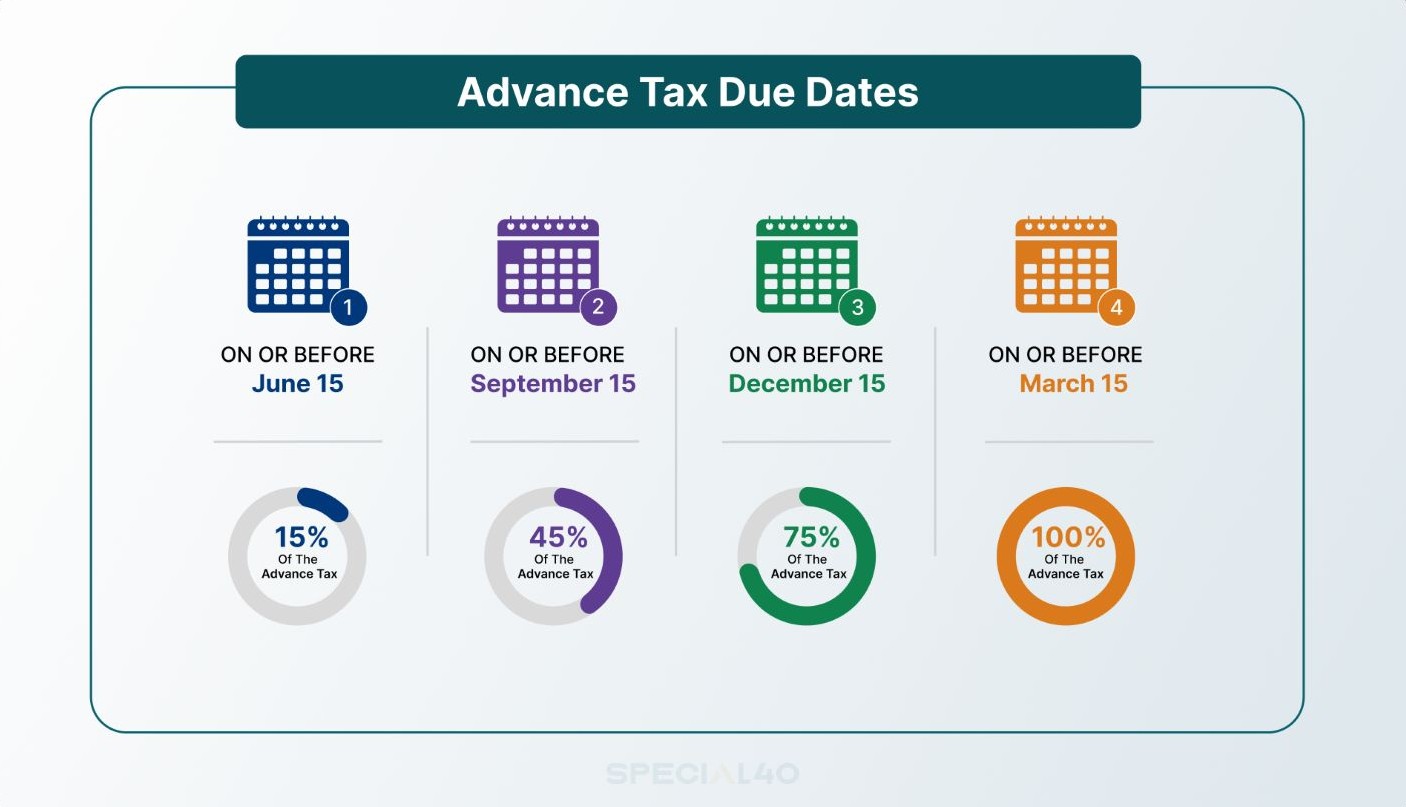
The Payment Schedule
For regular individual taxpayers, freelancers, and corporations, advance tax must be paid in four strict quarterly deadlines:
TDS vs Advance Tax: Side-by-Side Comparison
Feature | TDS | Advance Tax |
Who pays the government | The payer (e.g., employer) | The taxpayer, directly |
When it happens | At the time of payment | In instalments during the financial year |
Journey | Payer → Deducts Tax → Government | Taxpayer → Government |
Applies to | Salary and other specified payments | Professionals, business income, other income not taxed at source |
Both systems exist to help the government to receive tax regularly rather than having to wait for a large lump sum. The main difference is who collects or pays the tax and when?
Connecting All Four Concepts
Step back, and the full picture starts coming together.
GST follows a transaction: Customer → Business → Government.
Income Tax is based on income: Income → Taxable Income → Tax Liability → Government.
TDS changes who moves the tax money: Payer → Deducts → Government.
And Advance Tax changes when the taxpayer pays it: Taxpayer → Government, spread across the year.
When you understand how different taxes are collected makes the whole system much easier to see. Instead, they're a network of money journeys—each with its own route, timing, and set of participants. Once you understand this flow, tax rules become easier to follow and make much more sense in everyday life.
Conclusion
Once you see that TDS is about who moves the money and Advance Tax is about when it gets paid, both concepts stop being confusing and start to make sense. Understanding the concept is the first step — actually applying it to real payroll TDS deductions, advance tax calculations, and filings is where the genuine job-ready skill comes from.
That's exactly the gap Special40's placement-focused programme in Kochi is built to close — turning this kind of conceptual clarity into practical, workplace-ready payroll, TDS, and tax compliance skills.
FAQ
Why is TDS deducted from my salary?
TDS is deducted so that the government collects tax gradually through the year, straight from your income, instead of leaving you to pay one large amount at the end.
Who is responsible for depositing TDS with the government?
The payer is responsible — such as your employer in the case of salary — deducts the tax and deposits it with the government on your behalf.
What is the difference between TDS and Advance Tax?
TDS is deducted by the payer before the money reaches you, while Advance Tax is paid directly by the taxpayer in instalments during the financial year, based on estimated income.
Do I need to pay Advance Tax if TDS is already deducted?
It depends on your total estimated tax liability for the year. If your TDS doesn't fully cover your expected liability, you may still need to pay the remaining amount as Advance Tax.
What happens if Advance Tax is not paid on time?
Delayed or insufficient Advance Tax payments can attract interest under the applicable provisions, since the system is designed around timely, progressive payment through the year.