

Choosing the ideal course after 12th commerce is one of the toughest decisions many students face.
You may be a commerce student; do you actually know what to do after 12th apart from B.Com? For science students, it is either doctor or engineer due to peer pressure.
But for commerce students, most parents and teachers remain clueless regarding the right career path for them.
Neither parents nor teachers fully understand the roles available in the corporate finance sector, the skills they require, salary expectations, or the qualifications needed to pursue them.
In reality, there are numerous career pathways for commerce students to become expert finance professionals. The right one depends on their goals, personal interests, and strengths.
In this commerce career guide, we will explain everything you need to know about what to do after 12th commerce, including the right course, skills you must develop, the best career options, finance jobs, and salary expectations.
Top Career Options After 12th Commerce
Many believe that career options after 12th commerce are limited, but in reality, there are several opportunities that most people are unaware of.
As you may know, B.Com followed by M.Com or MBA is the most preferred course for many graduates to pursue high paying jobs in the finance industry.
Apart from degree courses, there are professional certification programs that finance aspirants can pursue after 12th commerce. These programs provide specialized expertise in areas such as accounting, taxation, auditing, finance, and investment. Successfully completing these programs leads to a highly rewarding finance career.
However, the right career path ultimately depends on your interests and strengths. Below, you will find a table and a list of commerce courses for students. The table below outlines the top certification pathways and the careers they lead to.
Course | B.Com | CA | CMA | ACCA | CS | CFA |
|---|---|---|---|---|---|---|
Difficulty | Moderate | High | Moderate to High | High | Moderate to High | Very High |
Duration | 3 Years | 4-5 Years | 3-4 Years | 2-3 Years | 3-4 Years | 3-4 Years |
Career Scope | Accounting, auditing firms, tax consultancy, business consulting firms, and other financial organisations. | Indian public practice, consulting firms, corporates, government, and audit firms | Manufacturing, FMCG, consulting firms, corporate finance, and strategic management | Multinational corporations (MNCs), global finance, shared service centers, and international accounting firms. | Corporate governance, listed companies, legal compliance, regulatory bodies, and consulting | Investment banking, asset management, private equity, hedge funds, wealth management, and capital markets |
Avg. Starting Salary | ₹3-5 LPA | ₹6–12 LPA | ₹5-8 LPA | ₹4-7 LPA; higher in international markets | ₹5-8 LPA | ₹6–12 LPA |
Best For | Student who aims for junior roles in accounting, banking, finance, taxation, auditing, business management | Students with strong skills in accounting/taxation who want to work in Indian-based firms. | Students aiming for global opportunities, MNCs, and roles involving international accounting standards | Students who are aiming for global opportunities, MNCs and roles involving international accounting knowledge | Students with a strong ambition towards corporate law, regulatory compliance, governance, and company secretarial practice. | Students who are familiar with capital markets, investment, asset management, and financial analysis. |
B.Com: The Most Popular Choice
B.Com is one of the most selected courses among commerce students. Every year almost one million students graduate with a B.Com in India. It covers a foundational awareness of finance concepts, preparing graduates for entry-level roles in accounting, auditing, taxation, and other roles in top companies. For entry-level roles, salary is estimated to be around ₹3-6 LPA. Since it is a general degree, most graduates pursue professional qualifications such as M.Com, CA, CMA, CS, or others to develop skills and knowledge to improve their career growth and potential.
Wondering what comes after B.Com? Read our detailed guide to explore the best courses after B.Com and choose the right career path.
BBA: For Future Managers & Entrepreneurs
BBA is similar to B.Com in terms of the duration and eligibility of the course as well as curriculum structure, but the concepts are focused on business management, marketing, human resources, finance, and entrepreneurship. This makes it suitable for entry-level roles in business organizations. Most BBA graduates opt for an MBA to pursue higher managerial roles with competitive salaries in top business organizations.
B.Com and BBA are academic degrees that help kickstart a finance career in entry-level jobs. Keep reading to find out the professional programs that can help you qualify for high-rewarding senior-level careers.
CA: Become a Chartered Accountant
Becoming a CA is challenging, as it has three level examinations covering an extensive syllabus that demands a thorough understanding of every concept to succeed. The CA profession is high-demand, offering exceptional earning potential, growth, and diverse roles in financial strategy, auditing, and taxation.
To learn more about the CA examination, including eligibility, syllabus, exam schedule, and registration, visit the official ICAI Examination Portal.
CMA: Become a Cost & Management Accountant
Cost & Management Accountant is a critical role in business organizations that supports strategic business decision-making, cost optimization, budgeting, financial planning, and performance management. Aspiring finance graduates can serve in this role by qualifying for the CMA examination. The CMA examination is of two types, one aiming for the Indian environment and the other for US corporations. Both qualifications focus on core concepts, but they have separate examination structures and syllabi tailored to their country’s regulatory frameworks and governance.
CS: Become a Company Secretary
Company Secretary is a high-level corporate professional role that has managerial responsibilities like legal compliance, corporate governance, and regulator filings within the business. Becoming a company secretary involves qualifying for the Company Secretary Examination, which comprises three part examinations: the CS Executive Entrance test, the CS Executive Program, and the CS Professional Program. Each of these exams has a different curriculum structure and concepts. Qualifying for these exams will help finance graduates acquire skills and expertise needed to build careers in senior roles in corporate finance, governance, law, and management accounting.
CFA: Become a Chief Financial Analyst
Chief Financial Analyst is a top position in corporate organizations. CFA also has a three-level examination. Finance graduates can become a CFA only if these exams are qualified. The CFA curriculum involves strong foundational knowledge about investment, and capital management that investment firms expect from finance graduates. Qualifying for this exam may open doors for senior roles like, chief financial officer, private equity portfolio managers, and others in investment management sectors or private wealth organizations.
ACCA: Global Accounting Career
While CA, CMA (India), and CS prioritize developing career roles within the Indian corporate and regulatory environment, ACCA is designed for gaining expertise in international law, allowing individuals to obtain promising global opportunities with competitive salaries. Commerce graduates need to qualify for the ACCA exam to become eligible for these global roles. The ACCA exam consists of 13 papers within 3 levels of exams. Completion of this professional certification exam equips graduates with a globally recognized certificate with skills and knowledge required to pursue finance careers across organizations in multiple countries.
Which Course Should You Choose?
The best career after 12th commerce depends on where your expertise, strength, and interest lie.
B.Com and BBA are academic bachelor's degrees suitable for any commerce graduate who aims for entry-level jobs in the business and finance industry.
For high-earning senior roles, the right professional certification should depend on your interests—whether in corporate law, management accounting, or global finance. Discover which course is best suited for your desired career path.
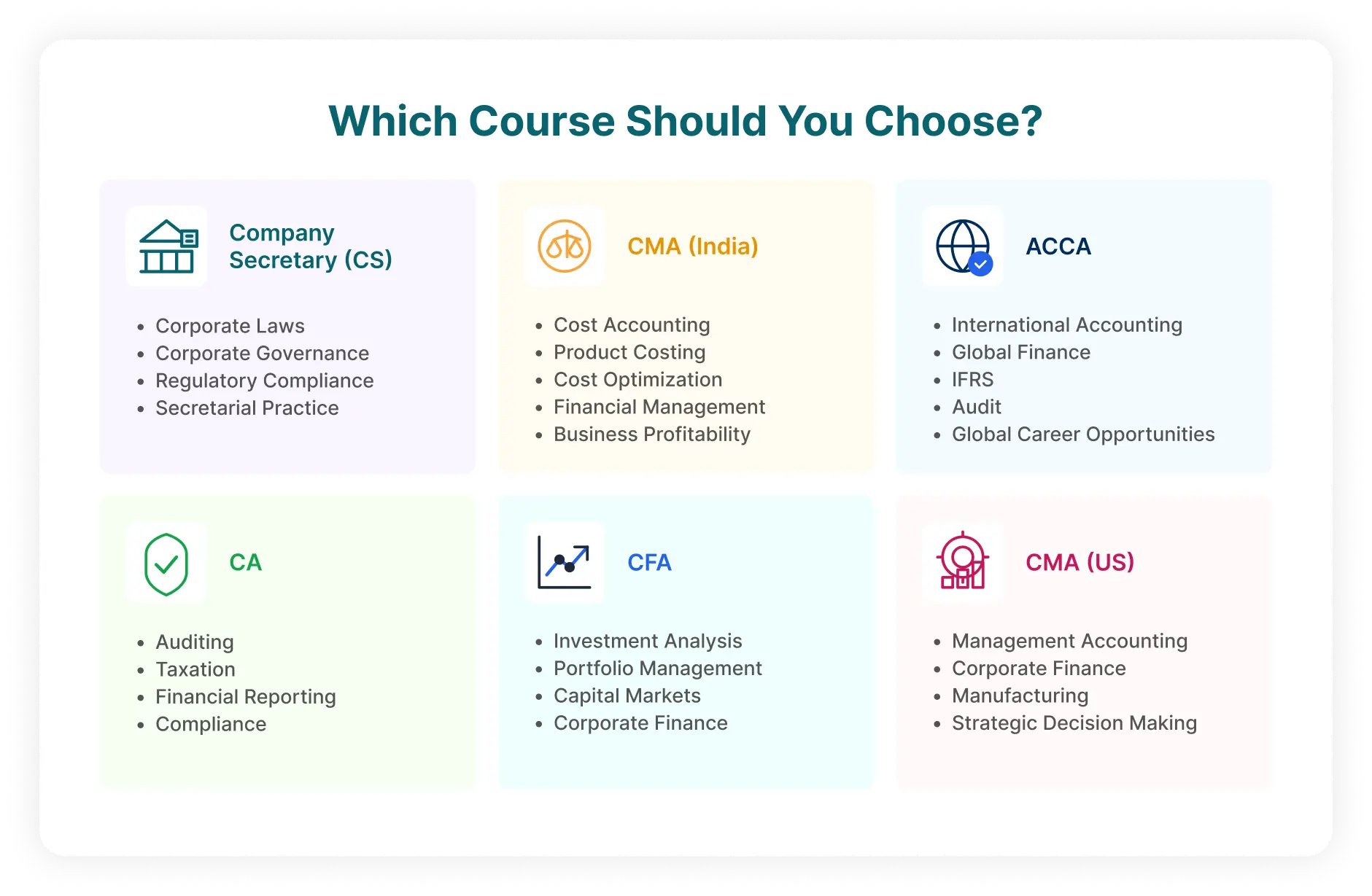
Consider Company Secretary
If you have a strong interest in corporate laws, regulatory compliance, corporate governance, and financial compliance.
Choose CMA (India)
If you are interested in understanding how products are made, what they cost, and how businesses in India can improve profitability by cost optimization.
Pursue ACCA or CMA (US)
If you are aiming for global opportunities, either of these professional courses is suitable. Choose CMA (US) if you are more passionate about manufacturing and production and ACCA if you have a strong interest in international accounting.
And CA or CFA
If you are curious about business and finance analysis. These certification courses open doors for high-salary opportunities. CA is ideal for auditing, taxation, financial reporting, and compliance, while CFA is best suited for investment analysis, portfolio management, corporate finance, and capital markets.
Biggest Mistakes Students Make
Commerce graduates often end up wasting their time and efforts because they invest in courses that don't align with their career goals. This typically happens because they are not aware of the different pathways available and lack proper guidance to make tailored decisions based on their strengths and interests. These are some mistakes you should avoid making:
Choosing a course because friends joined
A course that is right for someone else may not be the right fit for you. The choice of your course should be based on your personal career goals, interests, skills, and strengths, not your friends. Choosing the wrong course can have a negative impact on your career. Understanding where your interests and strengths remain is crucial before selecting the right course.
Following salary alone
A high paying job is always good to imagine. But in reality, competitive salaries are satisfied only when it is in a field that matches your interests and abilities. Otherwise, it can lead to years of dissatisfaction and limit your career growth. So, choose a career you can see yourself thriving in for your strengths and skills, not just the salary package.
Ignoring personal interests
One of the biggest mistakes is choosing a career that doesn't align with their strengths. Even within the finance industry, roles require different skill sets and abilities. For example, a student with strong business management skills may not thrive in international accounting and vice versa. So, picking a course that matches your strengths and skills has more room for better performance, greater job stability, and long-term success.
Thinking a degree alone guarantees a job
A degree is not enough if you don't have skills and abilities. A degree may help in securing an entry-level job, but its long-term career growth depends on the skills and abilities relevant for the job role. A degree is just a foundation. Practical skills and technical expertise are equally important. Combining the degree with the right practical skills and intention to evolve with new regulations and technologies, business practices are what lead to long-term success.
The mistakes discussed above can be avoided by understanding your skills, strengths, and interests, along with the qualities employers are actually looking for. Instead of rushing into a course without clarity, students who are unsure about their career path may consider skill development courses like Special 40. Not only does this course help to upskill, but it also enables students to understand the difference between each program, get practical, industry-relevant knowledge to become job-ready, and identify the qualification best suited to personal goals.
Skills Every Commerce Student Should Learn (Regardless of the Course)
Being a finance expert is more than having a degree certificate. Every employer in the modern finance industry demands industry-relevant skills. Here are some of the skills that every commerce student should learn to become a successful finance expert.
Practical Accounting
GST Compliance
Income Tax Basics
Advanced Excel
Tally Prime
Zoho Books
Financial Reporting
MIS Reporting
ERP Basics
Business Communication
Interview Skills
Resume Building
Presentation Skills
Still Confused About Which Commerce Course Is Right for You?
If you are still confused about the best courses after 12th commerce, then you must get the right guidance from experts. Having clarity on which course specializes in what expertise will help you determine the right course for you.
To get expert advice on finance careers, book a free one-on-one career guidance session with Special 40’s finance experts for a personalized roadmap based on your interests, strengths, and personal career goals.