

Are you looking for a successful career path as a Cost and Management Accountant in India? Then you need to read this before you enrol in a CMA course.
Cost and Management Accountant (CMA) is a promising career path in India, with the increasing number of businesses and growing demand for CMA professionals who can help organisations manage cost control and make informed business decisions.
In this blog, you will learn everything you need to know about CMA India course details for 2026, including CMA eligibility, duration, fees, course structure, career outcomes, and others.
What is CMA Course?
Cost and Management Accountant, which can be termed as CMA, is one of the career options open to students from the finance stream who have the ability to analyse financial data for preparing budgetary requirements and forecasts as well as making business decisions.
In order to become a cost and management accountant, it is necessary for students to enrol in the CMA programme and pass the exam conducted by ICMAI.
ICMAI is the statutory body that controls the Cost and Management Accountant programme in India. ICMAI conducts CMA examinations provides training and education, maintains professional standards and helps in development.
Many students feel that the role performed by the Cost and Management Accountant is similar to CA or CS professionals.
However, this is not true since CAs focus more on accounting, auditing, and taxation, while CS professionals focus on Corporate Law while CMAs focus on cost and business decisions.
CMA Course Eligibility
CMA India eligibility depends on which course the graduates are appearing for. CMA course has been divided into three;
CMA Foundation Course
CMA Intermediate Course
CMA Final Course
CMA Foundation Course
Eligibility: Candidates must have passed Class 10 and Senior Secondary (Class 12) or any equivalent national Diploma in Commerce examination from a recognised board/institution.
The Foundation Course is exempted for candidates who have:
Passed the Foundation Examination of ICSI.
Passed the Intermediate Examination of ICAI.
Qualified for direct admission to the CMA Intermediate Course.
Intermediate Course
Eligibility: Candidates can register for the CMA Intermediate Course if they have:
Passed Class 12/Senior Secondary and the CMA Foundation Course, or
Passed a degree from a recognised university except fine arts
Qualified through other eligible routes specified by ICMAI, including certain engineering and CAT qualifications.
Candidates can get direct admission if they meet ICMAI’s specified qualifications for the Intermediate Course without appearing for the CMA Foundation examination
The complete list of qualifying examinations is provided in Annexure VI on the official ICMAI website.
Final Course
Eligibility: Candidates registering for the final examination must have;
Cleared Intermediate examination
Completed practical training
CMA Course Exam Registration and Deadlines
According to ICMAI, registrations for CMA Exams are available throughout the year; however, students seeking admission in a particular term need to register before their respective deadline.
For June Exam: Deadline is 31st January.
For December Exam: Deadline is 31st July
The above deadlines apply to the concerned registration requirements for their respective exam terms.
ICMAI can also announce an extension of the deadline from time to time through notifications; therefore, it is advisable to visit the ICMAI official website for the latest information before registering.
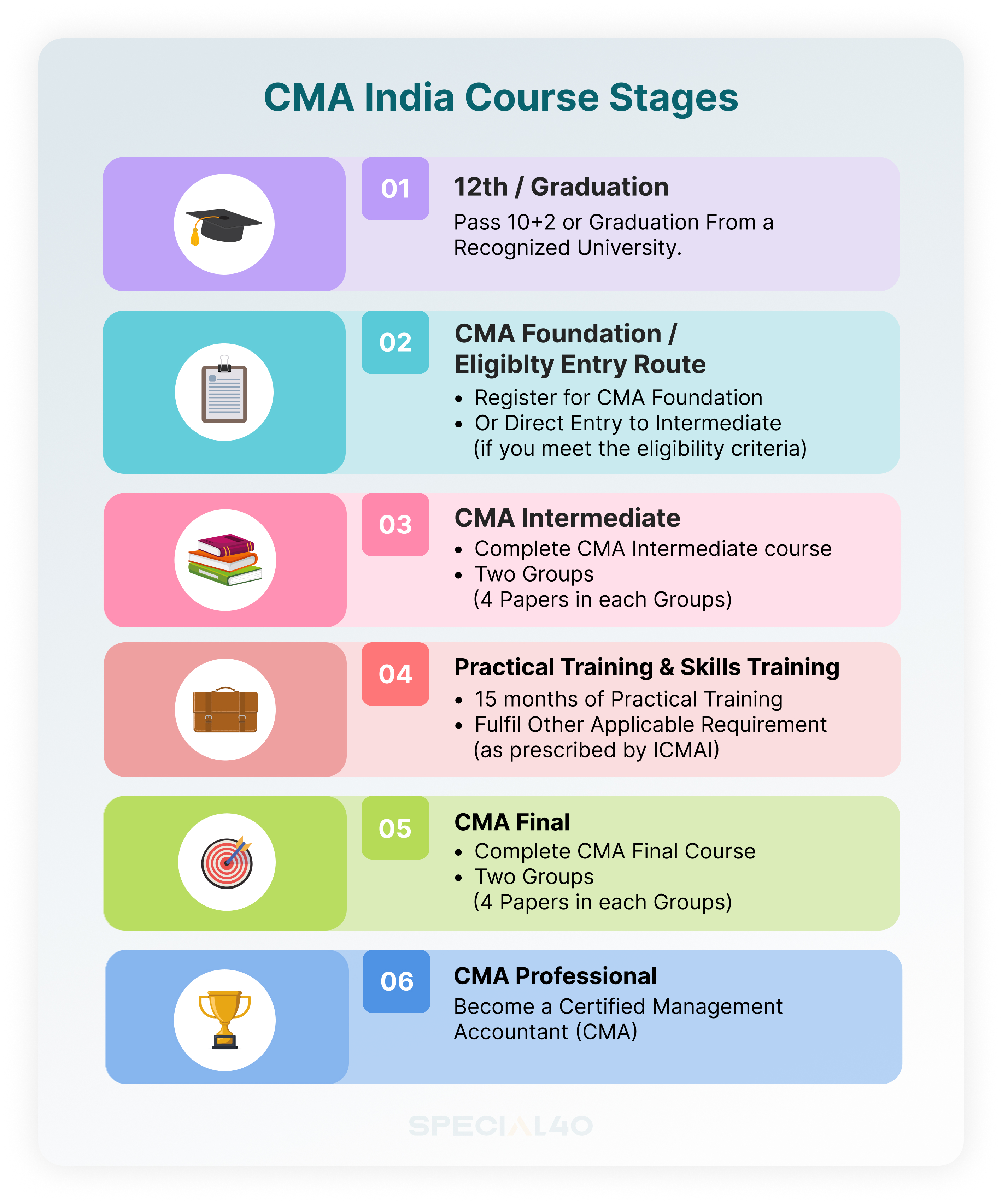
CMA India Course Structure & Syllabus Breakdown
CMA India course structure is different from CMA USA. CMA India has structured the course into three categories: CMA Foundation, CMA Intermediate, and CMA Final. Here you will find the CMA syllabus and subjects included in the three different courses.
CMA Foundation Level (4 Papers)
The CMA Foundation course has four papers. These four papers cover the fundamental concepts required for developing a basic understanding of cost and management accounting in businesses.
Course Structure
Paper 1: Fundamentals of Business Laws and Business Communication
Paper 2: Fundamentals of Financial and Cost Accounting
Paper 3: Fundamentals of Business Mathematics and Statistics
Paper 4: Fundamentals of Business Economics and Management
Exam Pattern
4 papers in total
100 marks per paper
50 MCQs per paper
2 marks for each question
No negative marking
Passing Criteria
To pass the CMA Foundation examination, a candidate must:
Score at least 40% in each paper, and
Score at least 50% in aggregate across all four papers.
CMA Intermediate Level (8 Papers | Group I & II)
CMA Intermediate course has eight papers, grouped into two categories. These papers focus on areas that help professionals analyse business performance and support decision-making.
Course Structure
Group I:
Business Laws & Ethics,
Financial Accounting,
Direct & Indirect Taxation,
Cost Accounting.
Group II:
Operations Management & Strategic Management,
Corporate Accounting & Auditing,
Financial Management & Business Data Analytics,
Management Accounting.
Exam Pattern
8 papers in total
100 marks for each paper
The examination includes objective and descriptive-type questions
Passing Criteria
A candidate generally needs at least 40% in each paper and 50% aggregate in a group to pass that group.
Mandatory Practical Training & Skills Training
During the CMA Intermediate course, practical training and skill training are mandatory. Skill training can be completed during the Intermediate course, and practical training must be commenced after registering for the Intermediate exam and before appearing for the Final CMA exam.
Skill Training
Skills Training Modules | Hours | Mode |
|---|---|---|
Tally ERP/Zoho/ERP Next/ERP etc. | 40 hrs. | Online |
Communication & Soft Skills | 20 hrs. | Online |
MS-Office | 40 hrs. | Hybrid |
E-Filing | 20 hrs. | Hybrid |
Intermediate Skills Training Requirement | 120 hrs. |
Practical Training
CMA students are required to complete 15 months of practical training, which can be started at the time of CMA Intermediate. Students have the option to undergo this practical training starting from their Intermediate level either under a Practicing Cost Accountant or within an organization/ industry.
Duration: 15 months
Starting level: Intermediate
Key areas: Cost accounting, financial management, taxation, auditing, and other business functions
Purpose: Develop practical skills and industry experience
CMA Final Level (8 Papers | Group III & IV)
The CMA Final course has eight papers, grouped into two categories. These papers focus on advanced areas of finance, taxation, cost management, reporting, and strategic decision-making.
Course Structure
Group III:
Corporate & Economic Laws
Strategic Financial Management
Direct Tax Laws & International Taxation
Strategic Cost Management
Group IV:
Cost & Management Audit
Corporate Financial Reporting
Indirect Tax Laws & Practice
Elective Paper
Exam Pattern
8 papers in total
100 marks for each paper
The examination is descriptive and case-study based
Passing Criteria
A candidate needs at least 40% in each paper and 50% aggregate in a group to pass that group.
CMA Course Duration & Fee Structure
CMA course duration is not fixed. The duration taken by finance graduates to complete CMA depends on their pace in completing the three different papers.
On average, a finance graduate may take 3 to 4 years to finish all courses from Foundation to Final.
The time required to complete the CMA course also depends on the entry route and how quickly a student clears each level.
Foundation Route: Students joining after Class 12 generally take around 3 to 3.5 years to complete the course, depending on their exam attempts and training.
Direct Entry Route: Graduates who are eligible for direct admission to Intermediate can skip the Foundation level, which can reduce the overall duration to 2.5 to 3 years.
A Typical Timeline
Foundation: Around 6–8 months
Intermediate: Around 8–10 months
Final: Around 8–10 months
Practical Training: 15 months, which can be pursued alongside the course as permitted by ICMAI
Overall, a student may be able to complete the CMA course in around 3 years or more, depending on the route, examination attempts, and completion of practical training.
CMA Fee Structure
Level | Approximate ICMAI Registration Fee | Duration / Study Prep Time |
Foundation | ₹6,000 | 3 – 6 Months |
Intermediate | ₹23,100 | 10 – 12 Months |
Final | ₹25,000 | 10 – 12 Months |
Practical Training | N/A (15 Months mandatory) | Concurrent with Final |
Total Estimated Journey | ~₹54,100 (Registration Fees) | 3 to 4 Years Total |
CMA Registration Process 2026 (Step-by-Step)
Here is a step-by-step guide on how to register for Cost and Management Accounting in 2026.
Portal Visit: Click on the official ICMAI website link and then enter the Online Admission Portal for Students.
Course Level Selection: Select the course level for which you are eligible (foundation, intermediate, or final).
Admission Type Selection: Select regular (if you have all the certificates) or provisional (if you are awaiting the final exam results).
Coaching Mode Selection: Select the coaching mode that you want (postal if you want the study materials to be sent to you or oral if you want classes at the local ICMAI regional center).
Fill out the Application Form: Fill in all the necessary details in the personal information, contact information, and academic information sections.
Upload Documents: Upload scanned copies of your passport-size photograph, signature, and educational certificates.
Payment: Make the payment online via credit/debit card/Net banking/UPI.
Confirmation: Print out the application form along with the payment receipt.
Core Corporate Career Pathways
CMA career scope extends to multiple specialized finance and management positions including:
Cost Auditor/Analyst – analyzing production costs, identifying inefficiencies, and maintaining compliance with Section 148 of the Companies Act, 2013.
Financial Controller – responsible for running the entire accounting function, internal control system, budgeting, and minimizing financial risks for the business.
Management Consultant – providing advice to Fortune 500 companies on pricing, operations restructuring, and profit margins.
Chief Financial Officer (CFO) – functioning as the strategic architect of the business, managing the allocation of resources, acquisitions, and the financial well-being of the firm.
Taxation Specialist – structuring both direct and indirect taxation solutions such as GST to increase cash flows of the business.
CMA is a structured course that helps students and graduates to start their career in cost management, accounting, finance, and business decision-making. The three levels, training, and career opportunities associated with CMA make the course an ideal qualification for those who want to pursue a financial profession along with business-oriented skills. Graduates can visit the official website for the latest information required and appear for the CMA course. Additionally, graduating as a CMA offers various opportunities in business industries with competitive salary packages. If you want to know more about the eligibility, fee structure, and exam pattern for CMA, visit the ICMAI official site.
Do you want to upskill in Accounting & Finance?
Build your skills in accounting, taxation, finance, and business with practical, career-focused learning at Special40.
FAQ
What is the eligibility for the CMA course in India in 2026?
To enrol in the CMA Foundation Course, candidates must have passed Senior Secondary (Class 12) or an equivalent examination from a recognised board or institution. Candidates can skip the Foundation level if they:
Have passed the Foundation Examination of ICSI.
Have passed the Intermediate Examination of ICAI.
Meet the direct admission eligibility criteria for the CMA Intermediate Course.
Can I do CMA after 12th Commerce?
Yes, you can start doing the CMA Foundation course after 12th Commerce.
Can I register for CMA Intermediate directly after my graduation?
Yes. Graduates from a recognised university can register directly for the CMA Intermediate course. ICMAI also provides direct-entry routes for certain other qualifications, including specified engineering qualifications
How long does it take to complete the CMA course in India?
There is no fixed timeline for completing the CMA course. It depends on the entry route and how quickly you clear the required examinations.
Is practical training compulsory before writing the CMA Final exam?
Yes, practical training under a Practicing Cost Accountant or within an organization/ industry for 15 months is compulsory before appearing for the Final exam.