

Interested in law, business, compliance and corporate management?
Then the Company Secretary (CS) course will be a great career option for you. This professional certification provides training to handle corporate laws, governance, compliance, and business laws.
Are you curious to know the duties of a Company Secretary and how to become a Company Secretary in India? Here is all the essential information about the CS course eligibility, subjects, syllabus, fee, duration, salary, and career prospects.
What Is a Company Secretary?
The Company Secretary is an important managerial professional who makes sure that an organization complies with all the legal, statutory, and regulatory issues.
The Company Secretary looks after the corporate governance aspect and also serves as an intermediary between the Board of Directors, Shareholders, Management, and the regulators such as MCA and SEBI.
The Company Secretary course creates experts in corporate laws, securities laws, corporate governance, compliance management, taxation, and corporate restructuring.
Unlike the conventional administrative secretary who works on documentation alone, the Company Secretary, besides being involved in documentation, has a critical role to play in matters of compliance and corporate governance. One difference between CS and CA is that while the CA focuses on accounting, auditing, and taxation, the Company Secretary is concerned about corporate laws and governance. The CMA professionals are more involved in cost management and management accounting.
What Does a Company Secretary Do?
Responsibilities of a Company Secretary:
Ensuring the statutory and regulatory requirements are met.
Maintaining statutory register of the company and the records.
Scheduling the meetings of the board members, shareholders, and other stakeholders.
Preparation of resolutions, minutes, and regulatory filings.
Handling the corporate filings and legal documentation.
Guiding the management on company law and its compliance.
Helping with mergers, acquisitions, and restructuring of the business.
A CS works closely with directors, management, regulators, shareholders and legal and finance teams.
How to Become a Company Secretary in India
The CS course is regulated by the Institute of Company Secretaries of India (ICSI). Usually, the CS course consists of three stages of education, namely CSEET, Executive Programme, and Professional Programme, depending upon the eligibility criteria. It is important for students to complete the mandatory training program and meet ICSI membership criteria to qualify as a Company Secretary.
CS Course Eligibility
Eligibility for Company Secretary is based on the mode of entry.
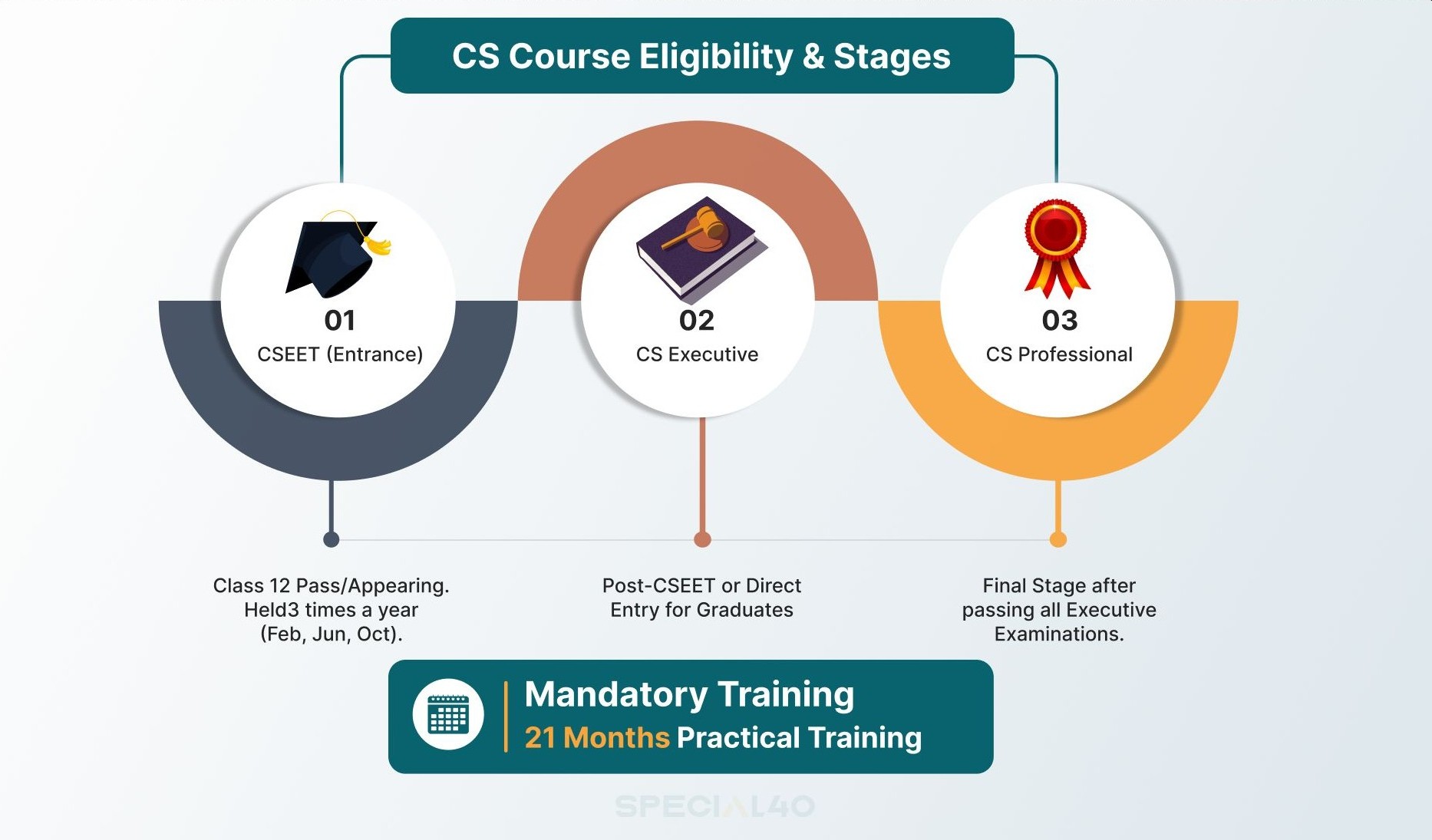
CSEET: Those students who have passed or are attempting Class 12 can enter by way of the applicable entrance test mode of entry. The revised CSEET syllabus will be effective from June 2026. CSEET is held 3 times a year; February, June, October.
CS Executive: Eligible candidates can register themselves post clearing the CSEET examination or by any of the applicable modes of direct entry or exemption, which include various classes of graduates and professional qualifications.
CS Professional: Applicants need to pass all the Executive Programme examinations before qualifying for the final stage.
Graduates, CA/CMA aspirants and others should check the latest ICSI guidelines for determining their eligibility for direct entry/exemption. Check the offical site of ICSI for eligibility and registration details.
Stage | Entry requirement |
|---|---|
CSEET | Class 12 eligibility under current ICSI rules |
Executive | CSEET pass or an applicable direct-entry/exemption route |
Professional | Successful completion of the required Executive Programme examinations |
Company Secretary Course Syllabus
The Company Secretary syllabus is developed in the following order starting from basics of business to advanced corporate law and governance.
1. CSEET: The entrance-level syllabus is intended to establish a foundation before students progress to more specialised company law and compliance subjects. In the newly designed entrance exam, there are four papers in total:
Business Communication
Fundamentals of Accounting
Economic and Business Environment
Business Laws and Management
CSEET is held 3 times a year; February, June, October
2. CS Executive: The CS Executive syllabus develops a more detailed understanding of laws, corporate practices, finance, and compliance.
Group – I ( 4 Papers)
Jurisprudence, Interpretation & General Laws
Company Law & Practice
Setting up of Business, Industrial & Labour Laws
Corporate Accounting & Financial Management
Group – II (3 Papers)
Capital Market & Securities Laws
Economic, Commercial and Intellectual Property Laws
Tax Laws & Practice
These subjects help students understand how businesses are established, regulated, financed, and managed within the relevant legal framework.
3. CS Professional: The Professional Programme focuses on advanced corporate governance, legal compliance, restructuring, finance, and strategic decision-making.
The outline includes the following subjects and elective areas.
Group - I ( 4 Papers)
Environmental, Social and Governance (ESG) - Principles & Practice
Drafting, Pleadings and Appearances
Compliance Management, Audit & Due Diligence
Elective -
CSR & Social Governance
Internal and Forensic Audit
Intellectual Property Rights-Law & Practice
Artificial Intelligence, Data Analytics and Cyber Security-Laws & Practice
Advance Tax Laws & Practice
IFSCA - Regulations, Listing and Compliances
Group - II ( 3 Papers)
Strategic Management & Corporate Finance
Corporate Restructuring, Valuation and Insolvency
Elective -
Arbitration, Mediation & Conciliation
Goods and Services Tax (GST) & Corporate Tax Planning
Labour Laws & Practice
Banking & Insurance - Laws & Practice
Insolvency and Bankruptcy - Law & Practice
Executive and Professional exams are held twice a year (June and December)
For more information, please refer to the official website of ICSI academics official ICSI academic portal.
Training Requirements for CS Students
Professional preparation involves more than examinations. Students must complete the training and development requirements prescribed by ICSI for their registration and course stage.
The outline identifies the following programmes:
Student Induction Programme (SIP)
Three Days Orientation Programme (TDOP)
Executive Development Programme (EDP)
Practical training
Corporate Leadership Development Programme (CLDP)
The outline mentions a one-month EDP and 21 months of practical training, along with a 30-day CLDP. These durations and their sequence should be verified against the current ICSI training rules before being treated as applicable to every student.
Training provides opportunities to connect theoretical knowledge with practical work, including corporate documentation, compliance procedures, legal research, and professional communication.
CS Course Duration and Fees
The CS course duration is determined by your route of admission, results of examinations and completion of practical training. You will normally need three to five years to complete the course but it varies individually.
The CS course fees consist of the registration and examination fees. However, you have to pay other fees for coaching and preparation separately. The overall fee will depend upon the program you want to join and your route of admission and fee schedule. Check the ICSI fee structure before registering.
Stage | Preparation / Exam Duration | Estimated ICMAI Registration Fee |
|---|---|---|
CSEET | ~3–4 months prep | ₹7,500 |
CS Executive | ~9–12 months | ₹18,400 (CSEET route) / ₹23,400 (Direct Entry) |
Practical Training | 21 Months mandatory | N/A (Stipend earned) |
CS Professional | ~12–15 months | ₹20,000 |
Total Fee Outlay | 3 to 4 Years Total | ~₹45,000 – ₹55,000 (excl. coaching & exam fees) |
Career Scope and Salary Expectations
CS is a very good choice of career for students interested in corporate law and governance especially when professional knowledge is combined with practical and technological skills.
Why CS Is One of the More Stable Career Choices
The requirement to have a whole-time CS is for all listed companies, or a public company having a paid-up capital of 10 crore or more, or a private company having a paid-up capital of 10 crore or more in pursuance of Companies act 2013 Rules. This isn't a "nice to have" hiring decision — it's a legal compliance requirement, which is exactly why in-house CS demand stays steady.
This requirement also shapes where the real opportunity sits for a working CS. The scope of a Company Secretary in a mid-size company spans core corporate governance, regulatory compliance, and strategic board advisory — meaning a CS at a growing ₹10-15 crore paid-up capital company isn't confined to routine filings. They're often the single point of contact managing board meeting compliance, statutory filings, and governance advisory for a company scaling toward its next growth stage, making mid-size companies a genuinely strong entry point for early-career CS professionals to gain broad, high-responsibility exposure.
Where can CS professionals work?
CS professionals may work in:
Listed companies and large corporate groups
Private and public companies
Multinational companies (MNCs)
Law firms and professional services firms
Consulting and compliance organisations
Financial services and regulated businesses
Independent professional practice, subject to applicable rules
Some potential career pathways include the following.
In-House Company Secretary: Corporate governance, board compliance and corporate statutory filings in a company.
Practising Company Secretary: Compliance audit, secretarial audit and due diligence services independent of any company.
Corporate Governance and ESG: Environmental, Social and Governance (ESG) reporting and governance processes are areas that professionals may explore as companies respond to stakeholder expectations and applicable reporting obligations.
M&A and legal support: Assisting with mergers, acquisitions, corporate restructuring and due diligence.
Additional career options can include working with listed companies, multinational companies, law firms and consultancy firms. With changing regulatory needs, those who have legal expertise and technological expertise along with relevant experience can opt for corporate advisory positions as well.
Company Secretary Salary in India
The Company Secretary salary is based on several factors including the years of experience, qualification, location, employer and job responsibilities. Indicative annual salaries include:
Entry-level CS: ₹5 lakh – ₹8 lakh.
Mid & senior-level CS with 5+ years of experience: ₹12 lakh - ₹25 lakh and above.
The salary figures quoted above are indicative, not guaranteed salary packages. Salaries at large listed companies and specialised advisory firms may differ considerably.
CS vs CA vs CMA: Quick Comparison
CS, CA, and CMA are professional qualifications with different areas of emphasis. The right option depends on the kind of work you want to do.
Course | Main focus | Suitable for |
CS | Corporate law, governance and compliance | Students interested in Company law, corporate affairs and regulatory work |
CA | Accounting, auditing, taxation and finance | Students interested in Financial reporting, audit and tax-related work |
CMA | Cost accounting, management accounting and financial decision-making | Students interested in Cost control, budgeting, profitability and business analysis |
There is no universally “best” course. The right qualification depends on your interests, strengths and career goals. Before making a decision, compare the syllabus, entry requirements, course structure, training obligations, and career paths for each qualification.
Conclusion
The Company Secretary course is a professional qualification for students interested in corporate law, governance, compliance, and regulatory affairs. Students can begin their journey after Class 12 through the applicable entry route, while eligible graduates may qualify for direct admission to the Executive Programme.
The qualification involves progressive examinations, professional training, and practical learning. Career opportunities can extend across corporate organisations, consulting firms, financial services, compliance, and corporate advisory.
Before registering, confirm the latest ICSI eligibility rules, syllabus, course fees, examination schedule, and training requirements. Choose the course based on your interests and long-term career goals rather than popularity alone.
Build Practical Commerce and Finance Skills with Special40
Interested in building practical commerce and finance skills alongside your professional studies?
Special40 helps students and graduates develop practical knowledge in accounting, taxation, finance, Excel, and other job-relevant areas. Strengthening these skills can help you connect classroom concepts with the requirements of real business environments.
Explore SPECIAL40 Finance Career Accelerator Program
FAQ
1. What is the eligibility for the CS course in India?
Students can join through the CSEET route after class 12 or eligible graduates and candidates can opt for direct entry pathway criteria to CS Executive program.
2. What is a CS course salary?
Salaries for entry-level CS can be anywhere between ₹5 - ₹8 LPA, whereas experienced professionals can draw a salary between ₹12 - ₹25 LPA or even more, based on the position.
3. Is CS a good career option?
Yes, CS can be a good career path for candidates looking to pursue careers in corporate law, governance, compliance, and advisory positions.
4. Is CS more difficult than CA?
Both courses are difficult professional degrees. CS has more weightage in corporate laws and governance than CA.
5. Can I do CS after 12th Commerce?
Yes. Eligible candidates can start their journey via the relevant CSEET entry route.
6. How many years does it take to become a Company Secretary?
It usually takes three to five years, depending on how you enter the course, the level you have reached in your examination and training completion.
7. Is it possible to join the CS course after B.Com?
Yes. A graduate of B.Com may be eligible for admission into the Executive Program according to the current ICSI eligibility norms.
10. What are the different stages of the CS course?
The important stages include CSEET, CS Executive, CS Professional and the applicable training and membership requirements.
9. Can I skip CSEET if I am already a graduate?
Some graduates may qualify for direct admission to CS Executive without taking CSEET. Eligibility depends on the degree and the current ICSI rules, so confirm your route through the official admission guidelines before applying.