

In India, over a million students graduate every year with a B.com. Yet, more than half of them struggle to find a successful career after B.Com. If you are among them and wondering what to do after B.Com, then you are not alone.
Finding the right course after B.Com is a massive decision for finance graduates, especially when there is no clarity on what skills each of the courses builds and what skills employers really demand in the finance corporate sector.
This is why every finance graduate, including you, needs a proper commerce career guide—one that breaks down the right career options after B.Com and helps identify the best career in commerce so that no one has to waste their time and money choosing the wrong career.
In this guide, we will dive into different courses for finance graduates so that they can identify the appropriate course to build their commerce career based on their interests, strengths, and skills employers actually demand.
Do You Really Need a Postgraduate Degree After B.Com?
Almost every finance graduate ends up selecting either an MBA, M.Com, or another PG course as their next step. These have been the go-to options for higher studies after B.Com for decades and largely still are.
A decade ago, an MBA curriculum was well suited to what employers sought at the time. But in 2026, is it still the same?
With the evolution of the business landscape and its operations, many professional courses like CA and CS are purposefully built around the exact skills employers are hiring for.
Instead of pursuing a broader curriculum in MBA or M.Com, finance graduates can now choose to go straight to the courses that get them the role they want.
With the availability of professional courses, every graduate should be asking, Do I need an MBA, or is an M.Com necessary, given how specific skills and certifications can now be achieved through targeted courses?.
And more broadly, if you're still unsure what the right PG is after B.Com, you can gain clarity by opting for a tailored course that helps you toward the right path, be it MBA, M.Com, CA, or ACCA. This is based on your strengths, interests, and skills.
What Should I Do After B.Com? A Complete Career Roadmap for Commerce Students
What you should do after B.Com should be purely based on your interests, strengths, and skills you have. If you are unsure which course helps you build what skills, then continue reading.
Here, you will find some top finance professional courses and what skills each one helps you build, and the finance sectors where you can get employed. Let's break down each one.
1. MBA Finance or M.Com: Which Is Better for Your Career?
An MBA or M.Com after a B.Com is a broader finance theoretical and practical degree that many finance graduates opt for. When comparing MBA vs. M.Com, you should understand that they both are different in their own distinct ways.
While an MBA is based on practical management, focusing on leadership and management roles, MCom is more theory and academic, based on advanced accounting & taxation.
An M.Com or MBA career in finance is well suited for those aiming for senior roles. An MBA graduate would be more suitable for corporate roles like management consultant and investment banker, among others. And an MCom graduate can get employed in managerial roles such as auditing, taxation, and others.
Whether you want an M.Com or MBA Finance career, it ultimately relies on your personal goals, strengths, and where you want to make a successful finance career.
2. Is CA the Right Career After B.Com?
Chartered Accountants (CAs) are well-known for their strong numerical skills. The CA course is designed to help individuals develop expertise in accounting, taxation, and reporting.
The basic eligibility requirement to pursue a course in CA is a higher secondary completion. Candidates who have completed graduation and senior secondary can also choose the CA course.
If you are considering a CA course after B.Com, it will help you build a strong foundation and get a membership for a reputed chartered accountant career in India.
The responsibility of CA is mainly to handle taxes, audit reports, and financial operations for business individuals and families based on the Indian business and tax laws. A career path in CA is well respected, and a CA’s salary is exceptional, exceeding ₹20-₹30 lakhs every year.
If you enjoy solving financial problems and want long-term career growth with a good salary in the finance industry, selecting a CA course might be the best decision.
For detailed information about the CA examination, including eligibility, exam schedule, syllabus, and application process, please visit the official ICAI Examination Portal
3. CMA Course Explained: Career, Salary, Eligibility & Job Opportunities
CMA, also known as the Cost and Management Accountant course, specializes in budgeting, accounting, financial planning, and management-level decision making in business. Overall, a CMA course is focused on cost-optimizing financial strategies rather than just reporting.
The eligibility for the CMA depends on whether you choose the local body (India) or the international (US).
For CMA (USA), the candidates must have qualified either B.Com or M.Com graduates.
For CMA (India), both higher secondary & university completed candidates can enroll in a CMA course. However, the paper required to attempt may vary based on their educational qualifications.
A CMA certification may help finance graduates like you to land positions like a cost accountant, financial analyst, finance controller, and chief financial officer based on your experience and talent.
A cost accountant as a career may help you earn around ₹6 lakh as a fresher, with experience ₹8-15 LPA and more than ₹20 LPA for senior roles such as Chief Financial Officer.
4. ACCA After B.Com: Is It Worth It?
Yes, ACCA is worth it for B.Com graduates who are looking for global job opportunities. ACCA mainly specializes in equipping individuals with knowledge and skills in international business laws to help navigate business to meet international standards.
ACCA is a valuable certification for those wanting a career in the global finance industry. As it opens the door for the global market, its popularity has led to increased competition, making it challenging for the candidates to secure a role in the global finance industry. .
Although ACCA offers wider global opportunities, its scope in India is limited because the country’s financial and accounting landscape revolves around Indian corporate law. Therefore, ACCA certification along with a CA or CS will make the candidate more promising for foreign and Indian job roles.
For ACCA eligibility, both higher secondary graduates and university graduates are eligible to enroll. However, the number of papers required may vary depending on the candidate's educational qualification.
Completing an ACCA course may help candidates to excel in both accounting skills and strategic business decision-making as well as apply for the membership.
With an ACCA qualification, candidates can secure jobs such as financial analyst and management accountant in global organizations, although these positions are highly competitive.
In India, same professionals who hold ACCA along with CA, CMA, or CS qualifications can earn between ₹8–14 lakhs each year, while senior professionals in these roles can earn upwards of ₹20 lakhs annually.
5. CFA Course Explained: Should Commerce Students Choose CFA?
The CFA certification exam follows a strong curriculum involving investment management, business finance, financial analysis, and other core financial concepts. A CFA exam preparation course covering these topics may help candidates build knowledge and skills. required to complete this exam and pursue a successful career as a chartered financial analyst.
A Chartered Financial Analyst is responsible for evaluating the financial operations of a company to help develop internal business decisions. A CFA certification also opens doors to a successful CFA career in managing investment funds and accelerates your path in portfolio management & investment banking, which makes it one of the highest-paying jobs in India and globally.
CFA eligibility consists of three parts. To appear for the exam, finance aspirants must be graduated and also should have work experience in the relevant industry. A CFA membership is acquired by completing these exams and other criteria.
Practicing CFA also pays generously. At the initial stage, CFAs may earn up to ₹6-₹15 lakhs, and the CFA salary package may exceed more than ₹20 lakhs for experienced professionals.
6. Company Secretary (CS): Everything Commerce Students Should Know
Company secretary course is built around business laws, the Companies Act, compliance, and governance.
A company secretary's role revolves around ensuring that the management adheres to the respective laws and regulations in the company. Qualifying all of the company secretary exams may allow aspirants to grab corporate roles like compliance officer, chief governing officer, corporate planner & strategic advisor, and others.
The eligibility for the first-level corporate secretary exam is senior secondary passed or appearing. For the executive program, the candidate must have passed CSEET within one year for senior secondary graduates.
For more details on Company Secretary (CS) registration, please refer to the official site: How to Register for CSEET
Top Career Opportunities After B.Com in 2026
If you are a B.Com graduate, you have several high-earning opportunities in the financial industry. Career opportunities after B.Com are many, but most of them begin in an entry-level position like accountants, tax consultants, and others.
For a high-paying income, B.Com graduates may need an additional professional certification like CA, CMA, ACCA, or CS to secure senior roles in the industry.
Here are some of the top career opportunities you can get employed in a high-paying job after completing B.Com with professional certification.
Chartered Accountant
Chartered accountants are highly reputed in India. As CAs's responsibilities highly weigh on Indian business and taxation laws, there are plenty of emerging opportunities for CAs. From startups to conglomerates, every business requires accounting, auditing, and tax compliance.
Investment Banker
Investment banking and portfolio management are other top finance jobs the employers seek. With growing businesses and investment opportunities, both individuals and businesses demand portfolio managers for investment strategies.
International Accountant
Global accounting has a soaring demand with businesses scaling and growing in different parts of the world. It also offers one of the most competitive and attractive salary packages in commerce jobs.
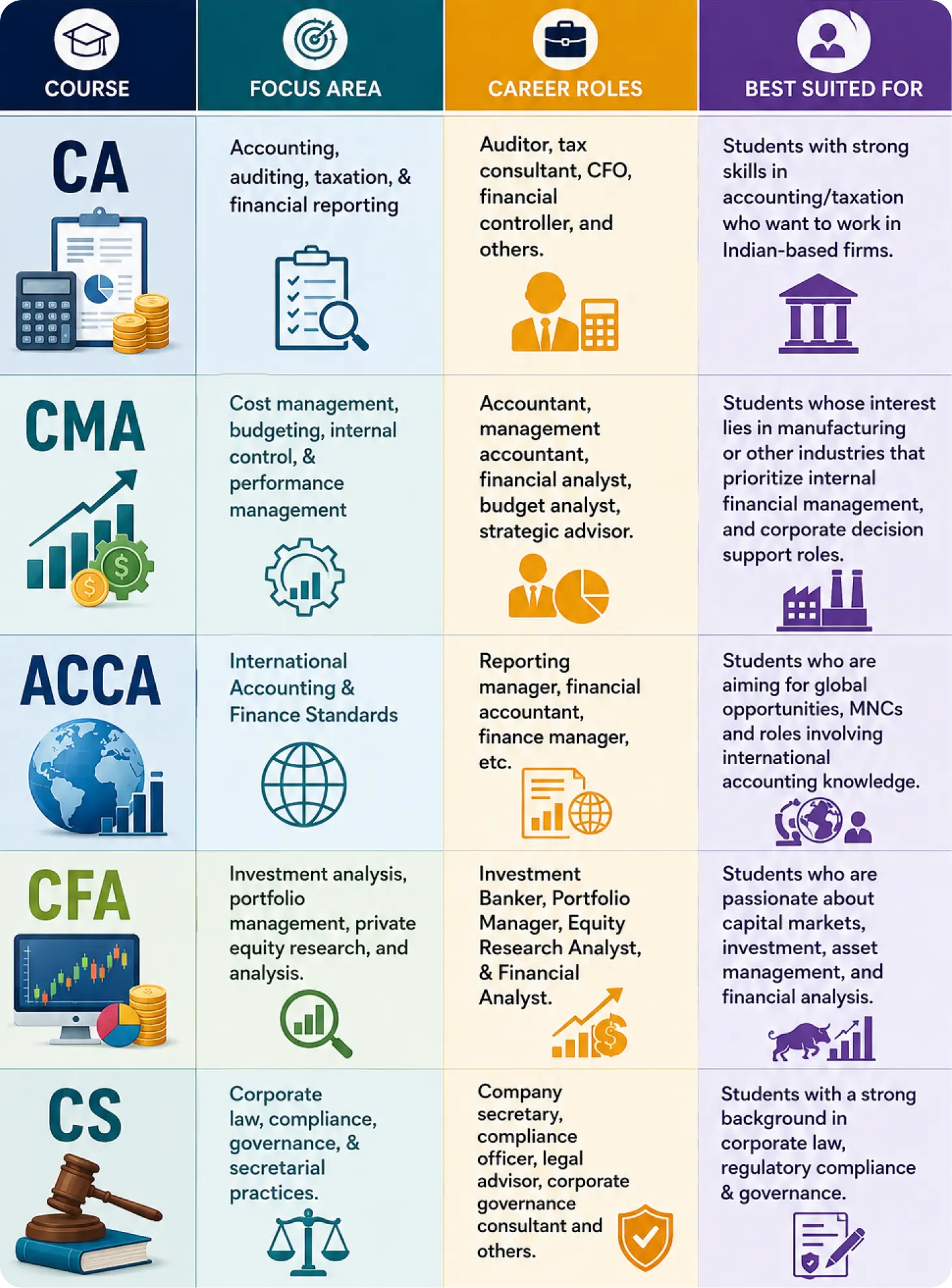
Choosing the right career after B.Com has been a struggle for many. And this blog has simplified that.
You may now understand the ideal roles for your strengths and interests, along with which examinations are required to qualify for them.
However, it is not the same for all—not everyone can easily find out what their strengths, skills, and interests are within the finance industry.
This often finds them stuck in deciding what the right career is or falling behind after deciding the wrong financial career. Overall, it creates a significant gap between candidates' career choices and industry expectations.
If you are aiming to bridge this gap, a professional career accelerator program like Special 40 may become useful to you. It helps candidates equip industry ready skills through practical learning.