

You have secured your B.Com degree, updated your resume, and applied for different jobs. But, you have not yet landed your first break. If this sounds familiar, you are not alone. Most commerce students struggle with this as doing a degree and being workplace-ready are two different things.
A B.Com degree provides you with a good theoretical understanding of accounting and finance concepts. But when applying for an accounting or finance job role, employers want graduates who are able to prepare reports in Excel, record transactions in accounting software like Tally or Zoho Books, understand GST compliance, and communicate professionally with colleagues or clients. That gap is where many graduates get stuck.
You don't need another degree for this. Learning the relevant skills, gaining the relevant experience, and preparing for interviews will make you a more competitive candidate.
In this guide, we will explore the skills for B.Com graduates that employers value, the jobs you can target, and practical steps you can take to become job-ready.
Why a B.Com Degree Alone May Not Be Enough
A B.Com degree provides essential theoretical knowledge in commerce, taxation, and finance, but employers look for practical application. They prioritize candidates who can easily translate that academic knowledge into practical, everyday business solutions.
College courses are designed around theoretical frameworks and written exams. But when you start working at a company or a firm, they expect you to know how to use Excel, navigate accounting tools, keep track of the company's money, and handle actual compliance paperwork.
For example, you might understand the concept of a journal entry from your textbooks. But can you record a sales transaction in TallyPrime? Can you reconcile bank statements in Excel? Can you identify a difference between two sets of financial records?
These practical abilities help employers understand how quickly you may adapt to a job.
The Skills Gap: What College Teaches vs. What Employers Ask For
Skill area | What college usually teaches | What employers ask for |
|---|---|---|
Accounting entries | Journal entries on paper | Entries in TallyPrime, Zoho Books, or SAP |
Tax | Theoretical GST and Income Tax laws | Filing, computing, and reconciling real tax returns |
Advanced Excel & Data Tools | Basic formulas | Pivot tables, XLOOKUP, data cleaning, and dynamic reporting |
ERP exposure | Little or none, as most colleges lack software access | Comfort with systems like Tally, Zoho or SAP |
Financial modelling | Concepts with simple examples | Financial forecasting, budgeting, and Power BI dashboards |
Communication | Written exams | Professional client emails, audit documentation, and team presentations |
Industry knowledge | A general curriculum | Awareness of how retail, manufacturing or banking handle accounts |
This does not mean your degree has little value. It means you need to connect your academic knowledge with practical work.
Core Technical and Software Skills Employers Want
To build strong job-ready skills after B.Com, focus on mastering these core technical tools and practical accounting skills.
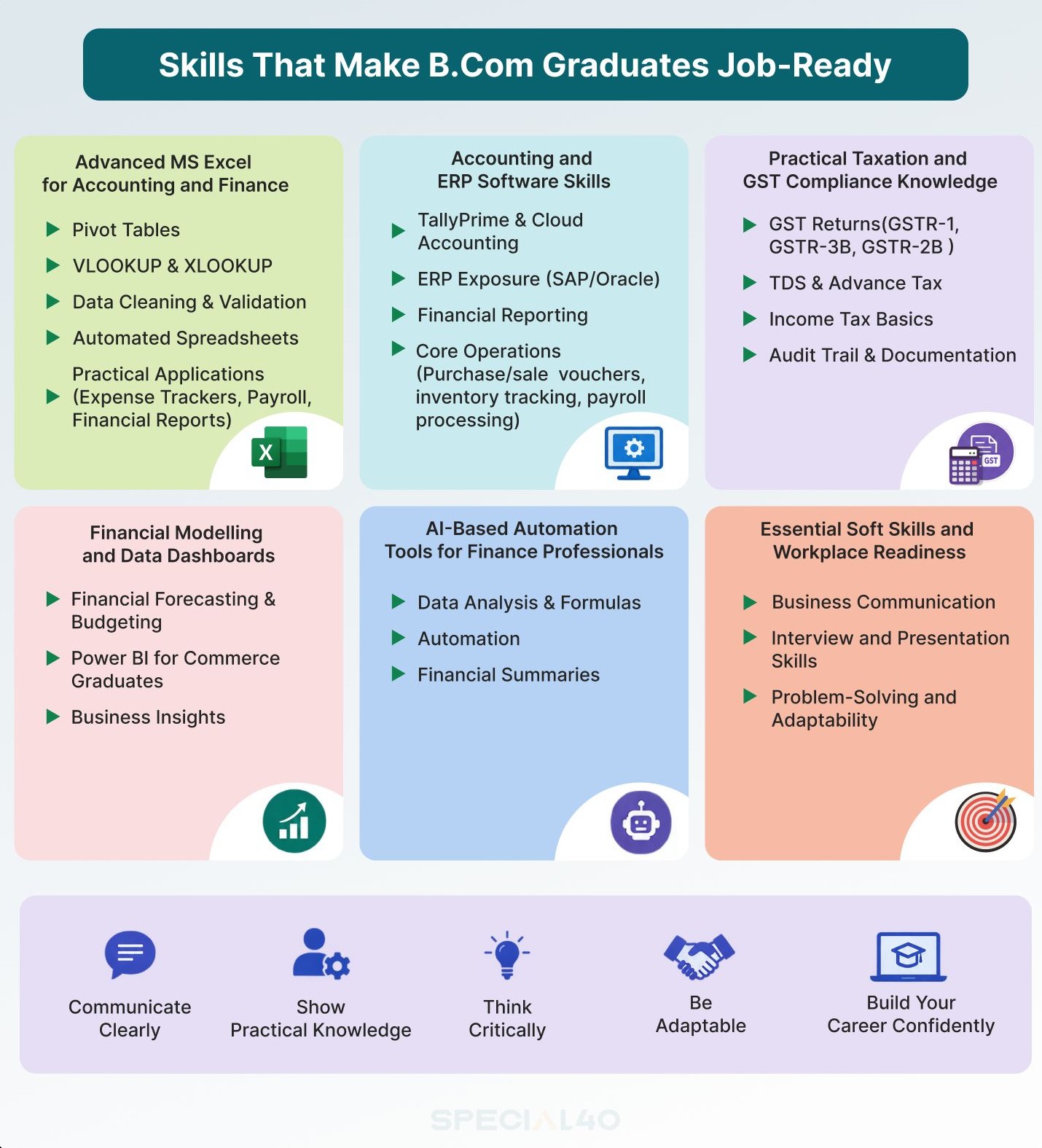
Advanced MS Excel for Accounting and Finance
Excel remains one of the most useful tools for corporate finance and accounting. Employers look for advanced Excel skills for commerce students, including:
Pivot Tables: To summarise large amounts of financial data quickly.
VLOOKUP & XLOOKUP: For matching, retrieving, and cross-referencing ledger data across multiple worksheets.
Data Cleaning & Validation: Removing duplicates, reformatting date entries, sorting messy datasets, and setting data entry rules.
Automated Spreadsheets: Designing dynamic templates for repetitive accounting tasks.
Practical Applications: Building expense trackers, bank reconciliation statements (BRS), payroll schedules, and financial report summaries.
Accounting and ERP Software Skills
Knowing theoretical debit and credit rules is not enough—you need hands-on accounting software skills. Employers expect you to know how to:
Record purchase and sales entries
Creating and maintaining ledgers
Performing bank reconciliation
Managing basic payroll information
Generate a trial balance and basic financial statements
TallyPrime & Cloud Accounting: Recording daily business transactions, setting up charts of accounts, and managing ledgers in TallyPrime or Zoho Books.
ERP Exposure: Understanding how enterprise systems like SAP or Oracle process large-scale accounting entries, inventory management, and purchase orders.
Core Operations: Managing purchase/sales vouchers, bank reconciliations, inventory tracking, and payroll processing.
Financial Reporting: Generating trial balances, profit & loss statements, and balance sheets at the click of a button.
Practical Taxation and GST Compliance Knowledge
Every business has to file returns on time, and many do not have enough trained people to do it.
Employers look for freshers who can:
GST Returns: Computing liability, preparing data, and understanding how to file and reconcile GST returns (GSTR-1, GSTR-3B, and GSTR-2B reconciliations).
TDS & Advance Tax: Calculating Tax Deducted at Source (TDS) rates across various payment heads, understanding deduction timelines, and managing compliance workflows.
Income Tax Basics: Computing taxable income, understanding tax slabs, and filing basic income tax returns.
Audit Trail & Documentation: Maintaining supporting receipts, invoices, and audit trails while spotting tax discrepancies early.
If you want a simple way to understand how these taxes work, read our posts on GST vs Income Tax and TDS and Advance Tax.
Financial Modelling and Data Dashboards
If you want to move beyond entry-level bookkeeping into FP&A (Financial Planning & Analysis) or MIS reporting, these skills will set you apart:
Financial Forecasting & Budgeting: Building revenue, expense, and cash flow projection models using Excel.
Power BI for Commerce Graduates: Transforming raw Excel data into interactive visual dashboards to showcase profitability, sales trends, and cost drivers.
Business Insights: Translating complex financial data into actionable visual insights for managers and stakeholders.
AI-Based Automation Tools for Finance Professionals
AI tools are now part of many finance teams. As a fresher, you can use them to:
Data Analysis & Formulas: Using AI assistants (like ChatGPT, Claude or Copilot) to generate complex Excel formulas, debug spreadsheet errors, and write macro scripts.
Automation: Automating repetitive reporting tasks, routine email drafts, and preliminary audit documentation.
Financial Summaries: Using AI tools to quickly parse and summarize long financial statements or regulatory updates.
A good prompt needs real skills behind it. An AI tool can only give you a useful answer if you ask it the right question, and you can only ask the right question if you have the practical knowledge about the work. A person who knows Excel, accounting software, GST and TDS can describe the task clearly. They know which data to share, which rule applies and what the result should look like. A person without those skills usually writes a vague prompt and gets a vague answer.
Crucial Rule: AI handles the quick, repetitive work, but a human professional must verify all calculations and outputs for accuracy and maintain data confidentiality. That analytical human judgment is what employers pay for.
Essential Soft Skills and Workplace Readiness
Technical skills can help you qualify for a job, but workplace readiness also matters. Two candidates may have similar degrees and software knowledge, yet the person who communicates clearly and handles problems responsibly may stand out.
Business Communication
Corporate Email Etiquette: Drafting concise, professional emails to vendors, clients, and internal department leads.
Financial Reporting: Writing clean audit notes, management summaries, and explanations of variance.
Verbal Clarity: Explaining complex financial figures clearly during team meetings, client calls, and cross-departmental reviews.
Interview and Presentation Skills
Practical Explanations: Explaining accounting workflows in your own words rather than reciting textbook definitions. Interviewers want to hear that you understand how things work.
Demonstrating Practical Logic: Confidently walking interviewers through how you would prepare a Balance Sheet, conduct a Bank Reconciliation, or handle a disputed invoice.
Problem-Solving and Adaptability
Error Detection: Spotting discrepancies in mismatched balance sheets, unrecorded bank charges, or duplicated vendor payments.
Reconciliation Skills: Methodically investigating differences during bank, vendor, or GST reconciliations.
Corporate Etiquette: Taking constructive feedback professionally, respecting office hierarchies, adhering to deadlines, and demonstrating eagerness to learn new software systems.
How to Bridge the Skills Gap After B.Com
If you are a B.Com graduate with no job, it is easy to feel that you are falling behind. Instead of trying to learn everything at once, focus on skills that match your target roles.
Take a practical certification course
Short-term training can help you build skills in areas such as:
Advanced Excel.
TallyPrime and accounting software.
GST and taxation.
Data analytics and Power BI.
Choose a course that includes practical assignments, demonstrations, and exercises. A certificate may support your resume, but your ability to perform the task is what matters most.
If you want a structured programme in Kochi, look at Special40, which is built around these skills.
Consider a professional qualification as a longer-term goal
You can also explore professional qualifications such as CMA or ACCA if you want to develop deeper expertise in accounting, management accounting, finance, or related areas. They work best alongside practical skills, not instead of them. If you are still deciding, our post on CA vs CMA can help. Pick a path based on your interests, budget, time and eligibility.
Build a Portfolio Through Projects and Internships
If you do not have formal work experience, practical projects can help demonstrate what you know.
You can:
Complete a sample bookkeeping project in TallyPrime
Build an Excel expense tracker or a small financial dashboard
Prepare a trial balance and basic financial statements from sample data
Do a practice GST reconciliation exercise
Take a short accounting internship or do supervised freelance bookkeeping for a small shop
What Jobs Can You Target After Building These Skills?
Once you equip yourself with practical accounting software skills, taxation compliance, and Excel mastery, you can apply for a wide variety of jobs for B.Com freshers:
Accounts Assistant / Junior Accountant
Accounts Payable (AP) / Accounts Receivable (AR) Executive
GST & Taxation Assistant
Payroll Assistant
Finance Operations Executive
MIS Executive / Junior Reporting Analyst
Junior Financial Analyst
How Special40 Can Help B.Com Graduates Build Practical Skills
If you have the degree but not the practical skills, Special40 is built for you.
Special40 offers an intensive 4.5-month, placement-focused accounting program in Kochi led by experienced Chartered Accountants (CAs). The program connects academic theory directly with real-world business tasks through hands-on learning:
Practical Accounting & Software: Master TallyPrime, Zoho Books, and Advanced Excel through live business case studies.
Taxation & Compliance: Gain practical exposure to GST return filing, Income Tax, TDS calculations, and Gulf VAT.
Workplace Readiness: Practice professional business communication, corporate presentations, mock interviews, group discussions, and corporate etiquette.
It is built to help fresh B.Com graduates into ready-to-hire finance professionals.
Explore Special40’s Finance Career Accelerator to discover how practical, hands-on finance training can launch your accounting career today!
Turn Your B.Com Degree Into Job-Ready Skills
A degree in commerce provides a good knowledge in accounting concepts. But practical skills are needed to secure a job. Learning Excel, Tally, GST filing, basic AI, and workplace communication will help you beat the competition and get hired.
Starting today, create a focused learning plan, practice with real-world datasets, build your project portfolio, and show to employers that you are ready to handle the job.
FAQ
Why can’t I get a job after B.Com?
There can be several reasons, including limited practical experience, gaps in accounting software skills, insufficient Excel knowledge, or difficulty explaining your skills during interviews. Review job descriptions for the roles you want and identify which requirements you need to develop.
Which skills do employers want from B.Com graduates?
Employers look for Advanced Excel, accounting software like TallyPrime, GST and TDS knowledge, and clear communication. Problem-solving and a willingness to learn also matter a lot.
Is TallyPrime necessary to get an accounting job after B.Com?
TallyPrime is useful for many accounting roles, particularly where businesses use it for daily accounting. However, it is not compulsory for every job. Check the software requirements in the job descriptions you are targeting.
What skills do employers want the most?
The top three skills employers demand are Advanced Excel, hands-on accounting software proficiency, and practical tax compliance knowledge (GST & TDS). Good communication often decides between candidates who are equal.
Which short-term course is best after B.Com for getting a job?
It depends on your career goal. Practical accounting and TallyPrime training may suit aspiring accountants, while Advanced Excel can support many finance roles. GST and taxation training may be useful for tax-related work, and Power BI can help if you are interested in reporting or analytics.
How can I gain practical accounting experience as a fresher?
Start with sample bookkeeping exercises, Excel projects, simulated GST reconciliation, and basic financial reporting. Apply for internships and entry-level roles where you can learn under supervision. Keep examples of your completed projects for interviews.
Is Tally enough to get an accounting job, or do I need GST and Excel too?
TallyPrime can be useful, but combining it with Excel, accounting fundamentals, and practical GST knowledge can make your skill set more complete. Employers may expect different combinations depending on their business and the role.
How long does it take to become job-ready after B.Com?
It depends on how much time you can give. With focused, hands-on training, many graduates can build the core skills in a few months.
Do I need to learn AI tools as an accountant?
Yes, basic familiarity with AI tools for accountants (such as ChatGPT or Copilot for Excel formulas, data analysis, and document drafting) is becoming an asset in 2026. However, human verification and analytical understanding remain essential.